Dealing with change in LIS – a personal perspective for #uklibchat

This blog post also appears on the uklibchat site for the chat of 6 August 2013, ‘The changing world of libraries and information‘. This post contains an additional reference to a blog post by the Library Loon on ‘steady-state librarianship‘ which was omitted from the version published by uklibchat – my error.

I have to change to stay the same
– Willem de Kooning

In this guest blog post for uklibchat I’ll talk about how I deal with change in my role at Senate House Libraries, University of London.

For my library masters I studied various models for describing change and how to manage change. I won’t dwell on these in detail but to give one example to think about, Lewin’s (1947) model describes change as a three step process:

  1. Unfreezing: preparing the organization for change, building a case, dismantling the existing “mindset”.
  2. Change: an uncomfortable period of uncertainty with the organization beginning to make and embrace changes.
  3. Freezing: finalizing the organization in a new, stable state and returning to former levels of comfort.

I use this model as a way of understanding a traditional view, sometimes presented as a “common sense” view, of change processes though I find the underlying assumptions in the model itself quite manipulative – for example the idea that to create change, the transient pain of change must be understood to be less for the organization than the pain of keeping things the same. Other models have more steps and so greater complexity. Kotter’s (1996) eight step change model is one example; at that level of complexity it reads more like “Kotter’s tips for implementing change” rather than a theoretical model.

The main things I take from these models and work experience are that:

  • The major challenges in implementing change come down to people rather than technology or machines.
  • The period of implementing change will be disruptive and uncomfortable, as a manager you cannot ignore but must engage with this.
  • Communication at all stages is key to a successful change process – including celebrating success afterwards.

At Senate House Libraries we’ve experienced a considerable period of disruptive change since the mid-2000s. One conclusion I’ve made from this is we are definitely no longer in the business of steady-state librarianship (Library Loon, 2012). Our “business as usual” now includes an implicit assumption that we need to constantly review and adjust our processes and services to meet changing needs and demands, hence my inclusion of Willem de Kooning’s wonderfully mysterious quote above.

This does not mean slavishly following every new trend in technology or being led by the nose by technology, particularly technology as repackaged and sold by library software and hardware suppliers, but actively maintaining current awareness and honestly evaluating the status quo as thoroughly as we do new ideas.

I say this because in some libraries I notice a willingness to subject the new thing in a change process to exacting and rigorous examination but not examine the status quo in the same way. There is an assumption here about the ‘rightness’ of our current approaches, whatever they happen to be. What I find troubling about this is the idea our way of working will remain ‘right’ for any length of time in a changing landscape. It is absolutely right not to try to fix something that isn’t broken or enact change for the sake of change, but this is something only knowable following evaluation.

For me the operational aspect of library service must inform strategic thinking and planning, as it’s those staff that are in constant contact with library members and understand the fine detail of the service. For this reason I involve my whole team in developing operational plans and contributing to strategy by identifying priorities for future work. My view is change shouldn’t just be something that ‘just happens’ to staff but something for all to take an active role in.

Personally I am influenced by approaches from IT as I have a systems background, and more broadly am influenced by application of researched-based and evidence-based practise in librarianship. To be clear I include qualitative research in this as an essential parter to quantitative research, adding much-needed richness and depth to our understanding of user experience and behaviour.

One change process at my workplace where I’ve used this approach is implementing a new discovery layer, or library catalogue, as part of our implementation of a new library management system, Kuali Open Library Environment (OLE). OLE does not have a traditional catalogue so a catalogue or discovery layer such as VuFind or Blacklight is needed.

To do this, we have built and developed the case for changing by:

  • Presenting about the project formally at all-staff meetings and individual team meetings.
  • Informal conversation with staff to answer questions and build awareness ‘things are happening’ around discovery.
  • Involving staff in thinking creatively about discovery in a workshop environment (I blogged about this aspect a few months ago).
  • Giving discovery the respect it deserves by treating it as a Web project that puts user experience at the core – and being seen to do so. This includes hosting a student from UCL Department of Information Studies doing ethnographic research on catalogue user behaviour.
  • Answer technical questions quickly and with confidence, including in-depth questions about SolrMARC (really) and metadata issues.

The important point for me as the head of our systems team is so much of this is not about technology, it’s about surfacing opinion and including staff in conversation. For example we’ve set up a beta test VuFind 2.0 instance to provide food for thought, but it’s not core

By necessity this blog post is brief, but I hope this specific example and the more general things I’ve said above help seed discussion for uklibchat.

References

Lewin, K. (1947) ‘Frontiers in group dynamics: concept, method and reality in social science; social equilibria and social change’, Human Relations, 1 (1), pp. 5-41, PsycINFO [Online] doi:10.1177/001872674700100103 (Accessed: 27 July 2013)

Kotter, J.P. (1996) Leading change. Watertown, MA: Harvard Business School Press.

Library Loon (2012) ‘Steady-state vs. expanding-universe librarianship’, Gavia Libraria, 22 July. Available at: http://gavialib.com/2012/07/steady-state-vs-expanding-universe-librarianship/ (Accessed: 7 August 2013).
Transcending the LMS – Jisc Library Systems Programme workshop

On Monday 15 July I attended Jisc’s Library Systems Programme workshop which summed up experience from the LMS Change programme and the various Jisc-funded pathfinder projects. Our Bloomsbury LMS project to implement the Kuali OLE library services platform at the University of London is not funded by Jisc, we were participating as part of Jisc’s wider community engagement.

Helen Harrop of Sero Consulting collected tweets from the day here – Jisc Library Systems Programme Event on Storify and Ben Showers blogged a summary of the day including presentations here – Library Systems Workshop.

Thanks to Jisc for organizing the workshop – super job.

On being provocative

In the afternoon I spoke on a panel with Owen Stephens and Martin Myhill. I was asked to be provocative and talk about what I want to see in my imagined library system of the future – what is on my systems wishlist?

What a great platform. I think systems librarians and shambrarians are good at provocative, sweeping statements as we often need to see things terms of complete systems and the structure and interconnectedness of their component parts. Add to this years of experience with libraryland systems, and the 2012-13 turning point where next-generation library services platforms started being deployed in our libraries and things get quite interesting.

As I prepared slides in advance I didn’t have much chance to tweak what I’d say over the day. Listening to Ann Rossiter of Sconul and Ben Showers of Jisc speak about the history of the project and the current landscape I worried I might just be telling directors and systems workers things they already know and agree with. Nice as motherhood and apple pie is, it’s not provocative.

I wanted to expand on my points and relate things other speakers said to my vision of how I think we should develop our systems. My sides from the day are available on Slideshare, but they were only intended as soundbites for me to talk around so I’ve reproduced those as my headings below.

[slideshare id=24426319&doc=130715jiscworkshoplmswishlistfinal-130719101716-phpapp02]

What’s I’ve missed out is a major point about the opportunity to disrupt our traditional procurement approaches to drive new systems and especially adoption of Free and Open Source software. This point was made by Ben Showers early on and it kept coming back to my mind over the course of the day, what I heard from Glyn Ryland of the Whelf shared LMS project about their next steps to procure and implement a new system was particularly thought-provoking. A blog post will follow on this in future.

Transcending the LMS

Transcending the library management system is the fundamental issue for me.

Next-generation library services platforms are now being implemented and deployed in libraries in higher education. They are a thing of concrete reality not of the imagination. For me the vision of the next-generation is hidebound and limited by notions of what is appropriate for libraries and what lies outside these systems.

I guess most of us in systems are familiar with the corporate slide decks library vendors present for these platforms. They are all similar with a circle of components such as discovery, resource discovery, ERM, perhaps even digital asset management and reading lists, grouped around the vendor’s core library system at the centre. The implication is the vendor understands the complete picture and you’re in safe hands buying everything you need from them.

There is something seductive about this, but for me it’s incomplete and self-limiting. There are risks here too, as Owen Stephens made the point that by buying from that one vendor, you might end up prioritizing ease over your strategic goals.

To unpack this with an example, I want a library system that understands metadata and content beyond library. So I imagine a system that can manage our library and archives metadata equally well and support cataloguing workflows for both. This will be possible because my future system won’t have one cataloguing user interface; it’ll be possible to build your own interface as needed for different staff and workflows. My future system would be built with an understanding of our need to move to linked data approaches to cataloguing (catalinking, if we must), and our need for cohesive presentation of different types of content and descriptive metadata while avoiding creation of yet more silos.

My system of the future would transcend the limited notion of a library system for managing local bibliographic data and providing inventory and circulation functions – and it could really exist! In the cataloguing examples above I’m cheating as these are features either being coded or planned for future Kuali OLE releases, not pie in the sky.

By and for higher education

I want a library system that does what an academic research library wants and needs to support our business. A system we can employ to improve user experience for our students, and the academics who rely on us for their research and supporting their teaching. But library staff and IT staff count too. Improving user experience for colleagues in the library, and system functionality for our IT departments smooths the operation and maintenance of our systems.

Some of this sounds abstract, but comes into sharp focus as I think of how many times I’ve run into problems with my favourite monolithic library system because it’s just not designed for a complex group of higher education libraries.

In defence of librarians

It’s a bit fashionable to say librarians don’t really understand concepts around service and should borrow ideas from other sectors. Retail springs to mind here. For my part I think librarians don’t appreciate how similar the customer-facing aspects of our roles are to those in IT services, and how service management concepts can be re-used in libraries.

However, as a professional I believe strongly librarians in higher education do know what we’re doing in supporting our core purpose as universities, and I have much less faith in software suppliers to do that. One point made on the day was it’s not just what library software supplier are doing doesn’t reflect what libraries need, but that it might not reflect what they themselves think they should be doing. Rather, they are doing whatever best creates value for the private equity firms that own most of them nowadays.

The Kuali Foundation ‘gets it’ in this respect as our subject matter experts – meaning librarians and other library workers with expert knowledge – sit within a foundation that includes development expertise in analysis, consultancy, and project management. That means you avoid pitfalls that you can imagine if I asked you to imagine a library management system built by librarians.

Enterprise, not libraryland

Having said all that I think we’ll get best use from our future library systems by focusing on what we’re good at, which is providing library services, rather than what we’re not, which is generic IT and systems administration.

To enable this my wishlist includes features that allow our future systems to be taken seriously by colleagues in IT and the wider university. This means stepping away from libraryland systems and towards enterprise IT.

So, expect to take various options for cloud hosting using commodity IT services to our IT department rather than a single ‘vendor cloud’. I expect the future system to plug into a standard enterprise backup system, and I expect it to support virtualized hardware without being overly fussy about which particular Linux distribution or virtualization technology it runs on. I expect to be able to cope with peaks of demand over the academic year by temporarily bringing in more (virtualized) application servers.

Open and interoperable

My future library system will be open and interoperable with documented, web-based APIs and will be based on service-oriented architecture. Here I am almost quoting Ken Chad in his presentation on the day word-for-word.

It will be possible to get data into and out of the system easily, in whatever machine or human-readable form we wish to describe. These will be standard features rather than expensive optional extras. I’m thinking of features at the level of then button present in Kuali OLE 0.8 that produces XML output from the bibliographic database to feed into a discovery layer.

I’m entirely opposed to building the hacked-together and kludgy solutions “made out of glue and string” as my colleague Tim Fletcher at Birkbeck, University of London calls them.

Any library technology company could and should be able to do this now: there are no excuses. In my view software supplies do understand this and are moving in the right direction. This is great to see as we have been asking for this for quite some years. The point where vendors start getting tricky is in trying to convince us that some limited “openness” in the form of open APIs and accessible data is quite enough, which finally brings me on to…

Free and Open Source software

My future LMS will be be released under a license that appears in the Free Software Foundation’s list of free software licenses.

Let’s get this out of the way, the GNU four freedoms are a matter of liberty rather than cost and for me are central as a wishlist item for a future library system.

However there are more sophisticated and nuanced arguments to be made in favour of Open Source software. Liberty is important for practical reasons because it drains away risks associated with having a single software supplier for support and development, and it provides a safe and secure future for our system that won’t be influenced by private equity firms buying up library vendors. Commissioning development specifically of an Open Source system would allow a group of libraries to pool resources without one partner ceding their control to others, or becoming locked in to the particular technology or development roadmap that suits the vendor best.

Happily, we know systems vendors agree Free and Open Source Software is good software, because they use this software themselves as components to develop and build their systems. It’s wonderful to see library technology companies generating value by selling this software. No sarcasm intended: it’s what that Free Software Foundation think too.

Discovery at Senate House Libraries: staff focus groups

Introduction

At Senate House Libraries, University of London we’re part way though our project to migrate our library management system (LMS) to Kuali OLE, a Free Software / Open Source library services platform. As a deliberate design choice OLE does not come with an online catalogue for end users, so we are approaching discovery as a work package in our LMS project. To this end I recently ran focus groups for staff to start to specify what goes into a functional specification for our discovery system.

Part way into writing my summary of the high-level requirements I realised I was writing something like a manifesto. I stopped and split this into a separate page in our Confluence wiki, and this is what I wanted to share with you. If you want to see something more like a specification for a library discovery / vertical search system, take a look at Ken Chad’s libtechrfp site on Vertical Search as a starting point.

Running focus groups

From my point of view it’s liberating to start with a clean slate for discovery and not with the limitations of existing library vendor solutions. There are a whole host of implications here, primary for me are not being tied to vendor development roadmaps and technology choices, and not having limitations from the LMS carry through to the discovery layer. So, I wanted to start with an open mind and not presume too much about staff received opinion or staff use of our existing discovery systems.

I asked participants to think about some questions as a prelude to a mix of small- and big-group discussion in a workshop context.

  • What’s valued in our current discovery systems, and what are outstanding problems?
  • What’s missing that should be included in the next discovery system?
  • What’s most important to researchers?
  • What would a good discovery system look like, and how would it behave?

I have to apologize for management-speak of asking what does good look like, but it’s a serious point. It is incredibly hard to describe what a successful new system would be like to use, but these are the things we need to be thinking about rather than say, a list of missing features in Innovative’s Encore Discovery versus their older WebPAC Pro catalogue.

Just to add that yes, testing with library members is to follow. This will include the usual usability testing that accompanies and informs any sensible, well-designed web project and also a more in-depth investigation into user behaviour using ethnographic methods.

“[We want] the moon on a stick”

These group discussions were incredibly productive and featured a good deal of imaginative and daring thinking about what a library catalogue should be and how it should behave. My favourite headline from these small group discussions was a page titled, “the moon on a stick”. I think this is a good starting point: we should think big and aspirational, not small and limited.

Our goal should be full discovery of everything including searching across books, journals, archives, images, and so on in a way that is clear about what you’re searching and provides options to include and exclude different content. In this context the local bibliographic database becomes the biggest of several databases that discovery draws from alongside the archives catalogue, eprints repository, and digital asset management system.

Unfolding complexity

So, how do we provide breadth and depth of discovery without overwhelming the reader with a firehose-like experience of masses of information; and impossible complexity that requires a LIS masters degree to understand?

The key point for us is discovery needs the ability to be as simple or complex as you want to at any given time. We need a way of providing a range of levels of complexity in the same system rather than hiding all the complexity behind an ‘advanced search’ link.

This doesn’t just mean copying from web search, as a single search box is very difficult to get right in the library context. Even if many libraries are going this way nowadays it is very hard to do it well and impossible to please everyone. On the one hand, old school OPACs rely too much on specialist knowledge of how the catalogue works and the structure of the underlying metadata that powers them. On the other, library attempts at single search boxes use keyword indexes that fail to make best use of the complexity and richness of that underlying metadata.

Instead we need an approach that respects the intellectual ability of our readership and the status of our institution, and respects the reader’s conceptual understanding of the library. Our approach should reflect the pride we have in being a library and our professional abilities as librarians, without attempting to turn readers into mini-librarians.

Discovery must include ways of bringing in complexity from a simple starting point, something web search engines can do quite well.

Readers shouldn’t feel they’re starting from a position where they’re telling the library, “I’m stupid”, or “I’m intelligent”. Discovery needs to reconcile providing a simple starting point with surfacing information that may be relevant, but is deep and complex. We know that buried somewhere in the clutter are results that are useful to the reader. The underlying technology may be very complicated but the experience of the system should be the opposite.

We need to meet the needs of different groups of users, or the differing needs of the same user. We know there are primary and secondary uses of our collections for the same person, and a reader may have a different approach in a different context depending on what they are using us for. Staff are users of the catalogue and discovery tools should be easier for staff, too.

User experience

To inform this ‘unfolding complexity’, discovery must bring in user experience concepts and best practise from elsewhere in and outside libraries. The starting point in our thinking here is discovery should be navigable like a modern web site is, and to achieve this it will be designed in a similar way to how our our website was designed. That is, similar approaches and techniques given a library spin that respects our role and the reasons readers choose to sign up for membership.

User experience is key to our web presence but it must be a theme throughout the services we offer: it can’t stop at the library website. There is a gulf between library websites and library catalogues and discovery that we need to bridge. Libraries spend time and money building good websites, but you’ll still find terrible usability when you move over to their catalogues. John Blyberg sums this up as:

The problem lies with inflexible and outdated systems rather than no-one bothering with usability testing or not caring about their readers. Our next discovery system can’t be another weird product from Libraryland that is disconnected from the approach we take when building our websites.

Objecting to my own methodology

I’d like to end on a little reflection about methodology and our subjective views of catalogues based on our experience and familiarity.

Many staff expressed a wish for a “simple”, “uncluttered”, “user friendly”, or “intuitive” interface as contrasted with a “busy”, “cluttered”, or “clunky” interface. I understand these wishes, and I think there is a certain know it when I see it gut feeling about overall user experience that makes something “simple” or “clunky”, but intellectually I know it’s difficult to unpack what these terms mean as they’re so subjective. You might guess a concern here is a term like “user friendly” being used as a proxy for personal preferences or familiarity, and there is a contrast between familiarity of staff traditional information retrieval interfaces versus familiarity of readers with modern websites that I think is important too.

So we do need to dig in! At this point the workshop format breaks down because it’s difficult to employ methods such as close questioning or laddering in a group work situation, you really need a one-to-one interview. However, I tried to unpick this as much as possible in the focus groups without anyone feeling too interrogated. For example, if the Encore feel is “cluttered” what is it that would improve it? What is it about the classic WebPAC Pro or another catalogue that is uncluttered?

I can see a danger here in acting as an interpretive layer or a translator between what someone says and what I think they really mean, and then how I think that should be implemented in a new discovery layer. In hindsight I wish I could’ve sat everyone down one-to-one and ran through some repertory grids to allow for comparisons between different catalogue interfaces based on those constructs such as “clutteredness”.

I had done this in my masters dissertation on library catalogue user experience and found it works really well, once you get over it being an “out-there method” (I smiled in agreement when I read that in Lauren Smith’s recent blog post on fieldwork).

This is something I may try as part of testing options for discovery interfaces such as VuFind and Blacklight.

Acknowledgements

Thanks to Andrea Meyer-Ludowisy (Research Librarian, Western European Languages) and Joe Honywill (Associate Director, Digital Futures) at Senate House Libraries for helpful discussion on the subject.

Practical suggestions for running your own Library Camp

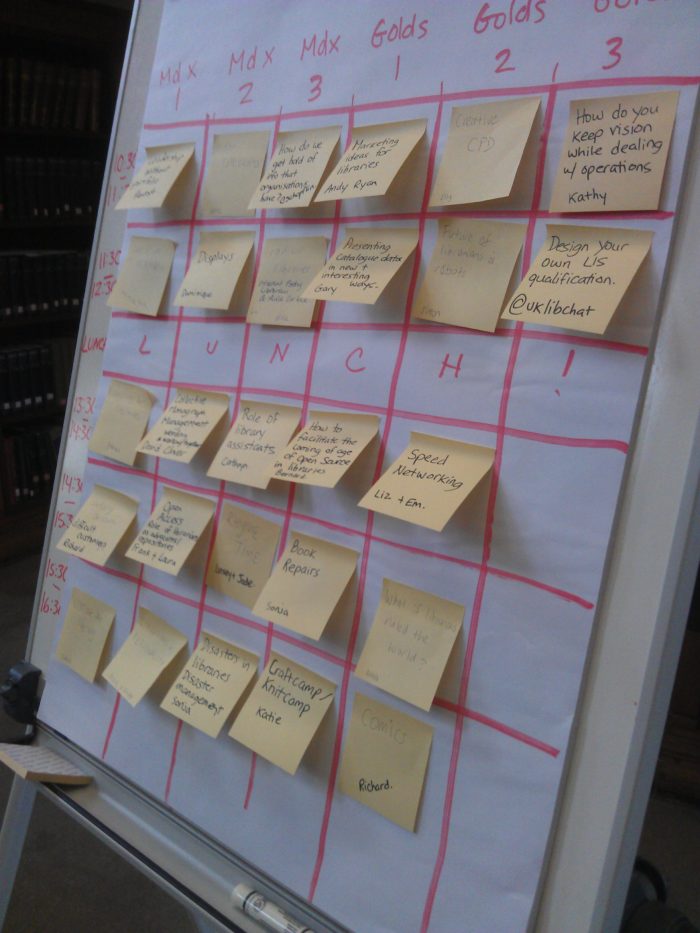
Library Camp London board following pitching.

So you want to run your own Library Camp unconference?

This is meant as practical advice in contrast to my reflective post.

I realized doing this was feasible when I attended a “Run your own Library Camp” session at Library Camp UK 2012 (blog post summarizing this from Carolin). With experience it’s fair to say the organizers of that session were modest, and underplayed how much work went into their events. It is quite some work – but less than organizing the equivalent size traditional conference would be. Here are my thoughts grouped into general themes.

Inclusivity

Alongside several other great ideas, Anne encouraged me to reserve places at Library Camp London for students. This meant they had the best possible chance of attending as they could be certain of a ticket and arrange travel more cheaply in advance. I expected better uptake if this came from lecturers themselves, so I circulated an advert for the unconference to colleagues at UCL, City University, London Met, and Brighton. I was able to sell out the student tickets in a day.

I wanted to ensure Library Camp London was emphatically cross-sector in outlook. I made contact with our local public library authority, London Borough of Camden, to ask about co-hosting. I had several reasons for doing this:

  • To widen participation and facilitate discussion and sharing between those from academic, public, special libraries, and non-library backgrounds.
  • At previous regional camps I’d noticed a tendency for attendees to be weighted towards the sector of the hosting institution.
  • To demonstrate how the University of London is engaging our colleagues beyond academic libraries. (We’re doing it; we need to demonstrate it too!)

I also contacted colleagues at special libraries to advertise the unconference internally, and spoke at a Camden Libraries Network meeting held at the Weiner Library to promote the event.

Encouraging contributions

Unconferences subvert the traditional conference approach as they are participant-driven and lack top-down organization. It was essential to maintain this spirit at Library Camp London.

However, I knew I could build interest by doing some groundwork. In practical terms this meant encouraging library folk to attend and pitch (this is easier over a drink), and talking to people I thought would have something interesting to contribute. Even those who could not make it in the end provided useful ideas, suggestions, and helped promote the event but talking to others. Additionally, I felt asking others to facilitate who hadn’t done so before was actively encouraging their development. Sometimes people just need a little nudge.

I was pleased we could provide a setting and importantly the technology needed to enable a live uklibchat on the day. I love the idea of a live uklibchat at an unconference but to be successful it is very technology-dependent so that aspect had to work perfectly – this means preparation.

Eventbrite

We had fairly complex requirements for ticketing and a waiting list and Eventbrite met these. It’s free and works.

The only thing I missed is a way of emailing the waiting list as you can with ticket-holders. What I did was export the waiting list to CSV and use that as the basis for a mail-merge.

On the day we needed effective ticketing as the library was open as usual. We used the Eventbrite Entry Manager app for Android to check-in on the gate. This was speedy and efficient with two or three of us present all the time. Eventbrite allows delegating limited access to your account to another user, so they can just do check-ins for an event without having access to the rest of your account.

I left a printed delegate list at our membership desk for latecomers, along with an example printed ticket.

Overselling

It’s sensible to over-sell tickets for a free event, the question is by how much. I found out other Library Camps have had drop-out rates between 10-25% but that has been highly dependant on things like transport problems on the day. We thought our central London location would lead to fewer drop-outs so I spent some time working out the limits of what we could do with our space. 150 library campers would have been too many but 120-130 would have been OK, I reasoned. I assumed a drop-out rate of about 10-15%.

We had 139 delegates on Eventbrite and checked-in 111 on the day. If I ignore those who cancelled after the point I could reallocate their tickets but did still cancel, it was 16% drop-out.

It was helpful to do several mailouts using Eventbrite ahead of the event to remind people who could no longer attend to release their tickets. Email is effective at this; asking on Twitter doesn’t seem to be. Richard had warned me about it, but I was still surprised how many people cancelled one day before the event. I was ready to go with a mail-merge for last minute ticket requests using my Eventbrite waiting list.

Unsure of final numbers, I found it very useful to have a ‘spare’ session location. I had planned three sessions in one room and two in another, but knew we could fit three sessions in both rooms if needed. We had pitches to fill those three spaces in both rooms for two of the morning sessions, so having an extra space pre-arranged was helpful.

Staffing and assistance

Having staff from Senate House Library available on the day made a huge difference to the smooth running of the event. In particular, my colleague Esme Stephens made strong contributions to several sessions alongside being a whirlwind of activity helping with the practical organization. If you can find one, have an Esme helping you.

Offers of help from others were appreciated, but unless it’s people involved from early on I’d recommend only accepting offers where you have a specific and defined job in mind. What I needed on the day were people to respond immediately to requests and take action. This would be very disruptive and somewhat unfair for someone expecting to attend the conference who had innocently offered to lend a hand.

Details

Details matter a great deal – they all add up to the overall experience of your venue and event. If you miss something it will be talked about in public and you’ll be apologizing for it.

  • Wifi / wireless absolutely needs to be working.
  • Make sure signs – including things like direction arrows – are printed correctly and ready to go before the event.
  • Make sure each session has flipchart paper and more than one pen.
  • Water bottles are better than glasses of water for carrying around a library. I accidentally ordered only fizzy water rather than a mix of fizzy and still which was an oversight.
  • We moved a lot of tables around for the event which uncovered carpet that needed a clean. Our cleaners were in there hoovering before I’d even asked.

Noise

I thought the choice of two big rooms was a positive one given experience from other unconference events that big rooms allow freer movement between sessions than small ones. People are uncomfortable getting up in front of everyone to leave a small room through a door/ Unfortunately it meant loud sessions disrupted quieter ones. The speed networking event and rhymetime sessions were quite loud – these were were both excellent sessions and brilliantly facilitated, but louder than the sessions next to them:

Ideally I would have provided separate space for especially quite or noisy sessions to be more contained. I was limited by the spaces actually available in the library though. I had initially planned to use different rooms including smaller spaces, but that would have made for a much smaller event.

What I learned from organizing an unconference

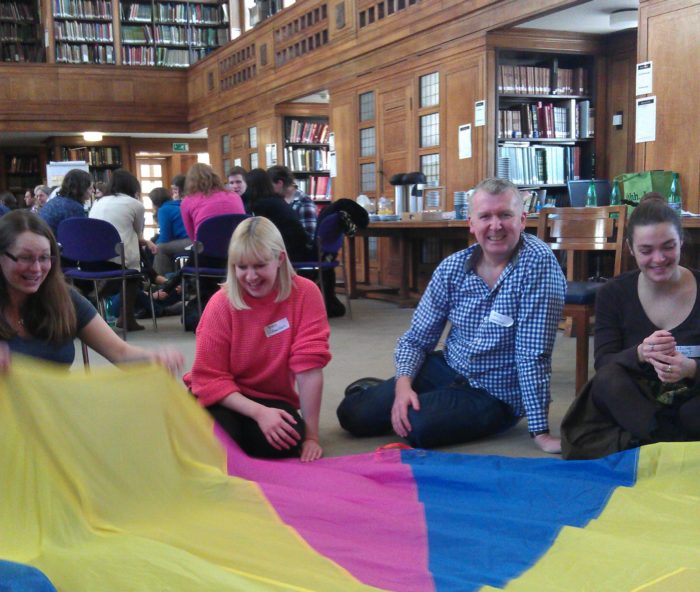
Jodie, Rosie, David, and Céline during the rhymetime session.

Reflection

Late last year in Somers Town Coffee House, Euston, I pitched the idea of running an unconference at Senate House to a group of librarians. They not only wanted to see it happen, but several of them including Gary offered to help right away. The idea itself wasn’t new as my colleague Les mooted running an event at Senate House after Library Camp Brunel

I’d imagined using the traditional, historic reading rooms of Senate House Library as a venue for hosting a fresh, modern conference – a combination of the traditional and the contemporary. I feel this is exactly what we managed to deliver.

Our location and size meant I thought I could make the unconference a bit bigger than regional library camps tend to be. We had 111 library campers including people from beyond library land, a very broad mix of sessions, and a delicious savoury lunch – although some subversives brought cake along too.

The highlights of the day for me were:

  • The rhymetime session run by Linsey and Jodie in our Middlesex South reading room had a transgressive feel and took most of us well out of our comfort zones. Informative, funny, and so different from anything I have seen at a conference before.
  • Sara‘s agreement to bring The Intinerant Poetry Library made for a really special part of the event for me. I was already a ‘Valued Patron of the Library’ and having a radical library like TIPL operate inside my own library has been a dream for some time.
  • Getting out of my comfort zone with hosting and organizing and event rather than just speaking or facilitating was very rewarding. I was scared at the thought of addressing 100+ library campers before pitching, but having done this once I know I can do it again and it will get easier and more natural.
  • Importantly for me, being able to make a contribution to other’s development by providing an event based on Open Space principles that allowed discussion to develop in an engaging and non-hierarchical way.
  • Lastly, I discovered Liz and Katharine both have truely awesome shushing ability.

Comments like these made my day:

Elly said:

Library camp was not only invigorating, but also liberating. All too often we get fixated on the idea of CPD in order to develop within our current role, essentially to get “better” at our current job. However, Library camp being free, and on a Saturday, meant that the day was solely for me as a professional.

The few days before the unconference were non-stop and the Saturday running the conference was intense. I promised myself I would not host anything this exhausing again too soon.

How come? We’d been removing desktop computers from our reading rooms gradually as we phase in Everyware mobile device lending, but the last PCs weren’t removed until Friday morning. On the Friday I was whizzing around Bloomsbury on a Boris bike looking for last-minute supplies – plastic knives and forks, Sharpie pens, labels, and paper napkins – as well as dealing with a slew of cancellations, getting furniture moved around by our portering team, and printing the signs and leaflets for delegates. Anything and everything that anyone else did to help was enormously appreciated.

On the Saturday morning I had an enormous feeling of relief when everyone started rolling in as expected, and made their way smoothly from cloakroom to lunch table to tea and coffee. During a lull Richard explained, “You’ve done it”, meaning the hardest part of organizing was over. He was right about this.

What next?

Following Library Camp London I’ve reflected on some of the limitations of an unconference for a generalist library audience. If you’re a specialist and want to present on something quite specialist, you may only be able to scratch the surface of what’s possible in discussion. Of course it is wonderful and encouraging that people come to learn and ask questions – indeed, that’s what I asked for during pitching at the beginning of the day. It was really interesting that a discussion notionally on Open Source library systems progressed onto talking about the value of children learning programming and the impact of Raspberry Pi, for one!

Having said that, I’ve realized there would be space for a library unconference in London with a technical or system focus. This could be hosted as a Mashed Library event, perhaps at Senate House later in the year. I am already thinking about Open Source Software / “openness” as a general theme. I feel I have broken my promise already…

Again, my thanks to all who contributed and made Library Camp London successful.

Librarians and personality – at Library Camp London

'Librarians and personality' session. Photo © 2013 by Annie Johnson, used with permission.
‘Librarians and personality’ session. Photo © 2013 by Annie Johnson, used with permission.

Introduction

This session grew from my thinking about extraversion and introversion in library workers. I was aware of a stereotype of librarians as being introverted, detail-focused, orderly, etc. but in my work I kept meeting extraverted librarians eager to deny that they are anything like that. Indeed, some were surprised that librarianship is thought of as an introverted profession at all.

I thought about a colleague from another academic library who was as extraverted a person as I had ever met. Whereas I was drained and ready for a lie down in a silent, dark room at the end of a day at at a conference, her energy had built steadily throughout the day and she was fizzing with it at the end. I also started noticing where the stereotype did seem to exist, for example a conference I attended where all the libraries seemed to have sent their most introverted staff, and my experience trying to run a focus group discussion with team-members all tending towards introversion.

Having opened with extraversion, you’d be right if you suspected Jung (1971) was my starting point. Following Jung, there are various approaches to classifying personality of which the Myers-Briggs Type Indicator (MBTI) is very well-known and widely applied. I personally prefer the Five Factor Model (or “Big Five”), as I’ve found it a better tool for looking at my own personality. The helpful thing about MBTI is that so many people have done an MTBI test, or at least know something about it, and that it has been used as a tool for looking at librarian personalities already.

In that respect we wanted to note we can only discuss what actually exists in the literature – we acknowledge tests used have flaws and limitations.

The landmark paper in this area is by Mary Jane Scherdin (1994). Scherdin surveyed librarians using a version of the MBTI. She found over-representation of introversion in the profession, with the most frequent MBTI types ISTJ (17%), and INTJ (12%). ISTJ is thought of as the classic librarian type: quiet, serious, thorough and dependable, orderly and organized, focused on details, and preferring a logical approach to planning work.

Pitch

Rosie and I therefore pitched this for Library Camp London:

Librarianship is sometimes thought of as the natural domain of a certain personality, in particular the introverted type. We disagree with this, and in this session we will challenge this perception and discuss how a range of personalities are suited to library work. Ahead of Library Camp London on Thursday 21st February uklibchat will be hosting an extra chat on ‘Librarians and personality’ to seed our session with ideas.

uklibchat

Ahead of our session we agreed with the uklibchat team that they would run a one-off special edition of uklibchat on this subject. The agenda is available and there is a very comprehensive and readable summary of the chat from Linsey.. We thought this would be an interesting subject for uklibchat discussion anyway, but wanted to do it for some specific reasons:

  • To surface views and opinions from library workers about any underlying truth to librarian personality stereotypes. This would provide starting points or seed discussion at Library Camp London.
  • To ask if there were things we could do at Library Camp London to encourage more participation from introverted types. This was in part a response to comments from Library Camp UK 2012 asking for this.
  • A major reason was to have the general discussion about this concept ahead of the session itself. In the session we knew we’d have 50 minutes total including about 25 minutes group discussion. This could easily be been eaten up by general discussion. From experience this can be a trap in unconference sessions.

This was a very busy discussion, busy enough for the #uklibchat hashtag to trend on Twitter UK-wide that evening.

We noted people were much more eager than I expected to do a Jungian type test, and discuss the results and what their type meant. There was some buzz about this on Facebook ahead of uklibchat, so we linked to a Jungian test from the agenda. I had been fretting about tests similar to MBTI being viewed as unscientific or worse mumbo jumbo, and I didn’t want to anchor the discussion to MBTI. I relaxed somewhat when people took to it quite easily.

In the chat the most unexpected thing for me was how much talk was about skills rather than personality. I mean by this that skills are something you can acquire, then work on and develop whereas I think of personality trains as a preference we can work with or against in different situations. We realized at Library Camp London we needed to be clear on personality versus skills, and what we were looking for from the group.

An interesting discussion about development opened up on the importance of making yourself do things you would not ordinarily as a way to grow as a person, which would be working against your preferences in personality terms. This was summed up marvellously by Penny as:

A darker side emerged when we discussed recruitment or interviewing and the place of psychometric tests like MBTI used to judge suitability for a job. The idea of a person being hired because they will ‘fit in’ to a team based on personality type was seen as especially problematic. My own view is team dynamic is very important, but there are better ways to look at this than a psychometric test. For example, I found an interview where I got to meet the team I’d be working with and be formally questioned by them to be a very good approach.

Library Camp London session

Following suggestions for making our session more inclusive or introvert-friendly, both in the chat and in a very thoughtful and detailed email from Joy, we decided on including a range of activities including a suitably engaging / awful (depending on your view) ice-breaker activity to get people warmed up.

The session was a large one. Obviously we were pleased so many wanted to attend – but I wondered how well the format would work. The ice-breaker was a brief explanation of extraversion and introversion followed by asking everyone to form a rough line based on how extraverted they consider themselves. I was in the middle as an ambivert whereas Rosie took up a position at the extreme extraverted end.

I encouraged the two ends of the line to look at those opposite and think about what they thought of each other in terms of what extraversion and introversion means to them. I think this worked quite well – the extraverted end were keen to start with their discussion points right away, skipping the group work…!

Small group work

We split into four groups, and had two groups each deal with one of these assignments:

  • Write down what you think of as the stereotypical view of a librarian personality seen from outside the profession
  • Write down what you think are the personality traits that are actually needed in modern librarianship

Here are photos of each page:

Group discussion

When we came back together for group discussion, I asking for someone to be brave and contribute thoughts on what they had written. The initial point made was the contradictions from the groups that worked on stereotype, even within the same group, including:

  • Sexy and frumpy
  • Conservative and left-wing
  • Old-fashioned and alternative, cool

Both groups included things that were not personality traits such as being female, but were in keeping with a librarian stereotype. Personal favourites for me were ‘radical… left-wing… vegan’ and ‘helpful (sometimes)’ – I liked how that sometimes brought to my mind a bad library experience right away.

Kathy Baro gave her view that we think about this kind of thing more as its what we do for a living. I wonder if this is librarians being self-obsessed, as discussed at the previous Library Camp Sheffield, or just good at reflecting on what is necessary for our roles and what makes us good at the job? (I err on the side of being positive here.) Looking at the stereotypes, there was a view that we are all quite confident and helpful compared with them – we’re all better than the negative stereotypes we had written down. We were reminded that ours was a self-selected group willing to come to a conference for work in our own time:

The group talked about the idea that a stereotype can affect the view of people we work with, but also the impression of those interested in joining our profession. We know librarian stereotypes are prevalent within our own organizations – colleagues may be surprised that you are a librarian when introduced. We wondered if the librarian stereotype means people may feel librarianship is a good career based on their introversion or shyness, or think they will get a quiet and bookish environment. This contrasts with how we tend to think of ourselves as outgoing and cool – is there a problem here?

Sam mentioned the usefulness of the enduring library brand being books and knowledge, so there is perhaps value in a library stereotype to identify the core set of skills that sit with these concepts.

I gave an example of personalities in a team context: I worked in a systems team where my manager liked big-picture thinking (intuition versus sensing in Jungian terms), I am very much the same, and my direct report was similar. So if everyone was looking at the big picture, who was going to focus on the details to make things happen? Of course – as Liz pointed out – really these are just preferences and we can work against them. Liz explained her view that a profile like MBTI is helpful as a starting point for self-knowledge. In a team-working situation we might find it effective to mould our approach to our line manager’s preferences, or from a management point of view we could ensure we can work around any missing personality traits.

This flowed into an interesting discussion about power and personality types in our workplaces. The point was raised that unless your organization takes personality on board in some way, hierarchy could just take over and you’re left coping as best you can. Liz’s view was power does come into play to an extent, but a good manager is one that will listen and make adjustments based on preferences.

An example given was a preference for up-front information can come across as confrontational, so it’s important to preface this with what you are going to do about it and why you are asking so many questions. Liz explained personality preference as a  way of getting around some of the intrinsic power structures in our organizations – for example it can be a way of depersonalising conflict based on it being an MBTI “thing” or preference when you’re explaining something to a colleague where you know you’ll disagree.

Tying this point back to self-knowledge, Linsey explained that understanding more about how you come across is very useful as a way of getting things done you couldn’t otherwise. I certainly agree with this having worked in flat management structures in education that absolutely require influencing others over whom you have no line management.

Acknowledgements

My grateful thanks to Rosie Hare for her hard work and enthusiasm in developing the ideas behind this session, reading quite a lot of Jung, and co-facilitating the session brilliantly. Thanks also to Liz Jolly for helpful discussion about personality, especially Myers-Briggs types.

Thanks to the uklibchat team – Annie Johnson, Ka-Ming Pang, Sam Wiggins, Sarah Childs, and Linsey Chrisman – for taking on the idea of an additional ‘special edition’ chat, and especially to Linsey for running the chat tightly and efficiently.

References

Briggs Myers, I. (1995) Gifts differing : understanding personality type. Palo Alto, CA: Davies-Black.

Jung, C.G. (1971) Psychological types. London: Routledge & Kegan Paul.

Scherdin, M.J. (1994) ‘Vive la difference: exploring librarian personality types using the MBTI’. In: Discovering Librarians: profiles of a profession (ed. M. Scherdin), pp. 125-156. Chicago: ACRL.

Library Camp London (#libcampldn) update

Update

A quick update about Library Camp London (#libcampldn) as I have been asked many questions on Twitter and by email this week.

We released general tickets on the afternoon of Monday 10th December. I did this about 2 pm and the response was spectacular, in about an hour we’d ‘sold’ them all and were building up an Eventbrite waitlist. I released a further 30 tickets to clear the waitlist.

We now have 100 library campers registered including advance tickets we released earlier for library and information students.

Thank you for your interest in Library Camp London. The excitement and buzz on Twitter and offline, especially people wanting to be involved in organizing and talking about their session ideas has been wonderful. What next?

Waitlist

Although you’ve missed the first ticket release, you can register to join the waiting list for Library Camp London tickets.

If you are interested in attending Library Camp London, please join the waitlist. This is because when we release more tickets those already on the waitlist will be offered them first.

Venue

I am working with my employer (and Library Camp host) Senate House Library, University of London to make more space available for Library Camp London.

We want Library Camp London to be as inclusive and diverse as possible. In particular although we’re hosting the event at an academic library, it’s not focused on academic libraries or higher education. For this reason we’re making a case to make the event bigger.

Ticketing

There will be at least one further ticket release for Library Camp London. This is likely to be in January 2013.

Please watch for announcements from me (@preater) and the other organizers Gary (@ggnewed) and David (@davidclover) on twitter.

Links

Free and Open Source Software and distributed innovation

‘The battle of the library systems’

On 28 November Senate House closed early for the University of London Foundation Day,  our annual celebration of our grant of royal charter on 28 November 1836. As the library closed down I made the short journey to Cilip HQ to attend the “Battle of the Library Systems” event organized by Bic.

This event was a panel debate between two sets of speakers in favour of Open Source software (OSS) and proprietary software. I was speaking in the Open Source “blue corner” alongside Dave Parkes of Staffordshire University and Nick Dimant of PTFS Europe. Sadly, Mark Hughes of Swansea University was ill and unable to attend and speak as planned. In solidarity the open team shared between us presenting Mark’s slides.

The house motion was:

Open source is about distributed innovation and will become the dominant way of producing software.

This is a quote from Talis – slightly modified from the original – from the Jisc and Sconul LMS study (Sero Consulting, 2008).

I will say a little about the arguments I made in favour of the house motion and what I thought were some strengths and weaknesses with the proprietary team’s arguments. Mick Fortune summed up as a guest speaker and I’d recommend reading his blog post ‘BIC Battles – Open Source or Proprietary?‘.

My argument

I opened by explaining our situation. Senate House Libraries and the colleges that make up the Bloomsbury Colleges group recently made a decision in principle to select Kuali Open Library Environment (Ole) as our next library management system. We have chosen an OSS system which will be run on a shared services model by the University of London.

Why is Open Source software a good fit for higher education?

I explained I prefer the older term Free Software to Open Source as it’s conceptually broader. Thinking in terms of one dimension – software development with access to the source code – sidelines the underpinning philosophy of community, sharing, and respecting software users’ freedom.

The audience was mainly academic libraries and I argued that our industry, higher education, has a culture of sharing and collaboration and librarianship is collaborative as profession. The same point was made by the proprietary software panel, but I go further and argue this therefore makes the software a good fit for us.

Kuali Ole is a library services platform being developed collaboratively by universities and their software development partners specifically to meet the needs of academic research-focused libraries. Ole is an enterprise-level system that we intend to use for business-critical services within our consortium. It will be cloud-hosted and managed collaboratively to provide a stable and trustworthy service – about as far as you can get from the idea of a keen systems librarian installing a Linux distribution on an old server and deciding to ‘give an Open Source LMS a whirl’.

I argued the key differences with Ole are that:

  • It is a true library services platform rather than a traditional library management system
  • As it is collaboratively-developed OSS we have the possibility of developing the software to meet our needs

It is the Free or Open Source licensing that is important here, as it effectively provides a strong position of sharing by default to the development model used in the foundation. Effectively, sharing and collaboration is baked in to the product and the processes used to develop it.

Proprietary software suppliers and Open Source software

Among the strongest arguments in favour of OSS for library systems is the range and variety of OSS used by proprietary suppliers themselves. Examples are most prevalent in next-generation discovery engines where Apache Solr and Lucene are used extensively, but in other library systems Postgres, Apache Tomcat, and of course the Apache http server are used widely.

I think proprietary supplies use OSS because it represents best-of-breed software that is stable and well-supported, and importantly flexible and free to use. It is licensed in a way that allows development and may be used for any purpose. This is why I emphasised freedom or liberty initially: while proprietary software suppliers enjoy the benefits of OSS themselves they’re not so keen on passing those freedoms onto us, libraries that buy their software and support services.

Suppliers’ use of OSS was acknowledged by the proprietary team. Jim Burton of Axiell mentioned extensive use of OSS throughout the company with an estimate of something like 500 different pieces used in their processes – though I expect this includes things like development tools and that the amount of OSS in their finished products is much less.

It is difficult for software suppliers selling systems based on Open Source to argue against Open Source. In using it in your own products you are vouching for it – and also undermining your arguments against it. For me this ubiquity in use and development is a compelling argument in favour of Open Source becoming the dominant way of producing software in the future.

Choosing software pragmatically

Jim made what I felt was the best argument against OSS for a complete library system directly relevant to my own experience in higher education. That was that the license is of secondary concern if the software does what you want and meets your needs. That software has an Open Source license doesn’t mean it’ll be a good fit for a given specification – relevant in a software ecosystem with relatively few complete OSS library systems as options.

I take from this that in practice our assessment process should lead us to choose pragmatically based on need rather than buying something because ‘it has a badge’. For many libraries that choice would mean proprietary software as best fit to a specification: perhaps an LMS with open and standards-compliant APIs allowing development work, perhaps cloud-hosted, perhaps with developer communities, perhaps itself built from OSS?

Distributed innovation

I argued as a software development method Open Source and open collaborative development methods make sense in our increasingly complex and networked world. I borrowed a term from David Weinberger here, that that nowadays knowledge has become “too big to know” (Weinberger, 2012) particularly evident in higher education with the complexity and sheer scale of research data.

It is a distributed and networked development approach that has created successful projects such as the Debian GNU/Linux distribution, and indeed the Linux kernel itself. One reason for the success of these projects is networked expertise: the ability to surface skills and knowledge from a globally-distributed community of developers. To apply this to library systems software I argued suppliers building systems based on a closed approach cannot respond to our changing needs as one based on networked expertise with ‘peaks’ of local knowledge that best understand our own situation and requirements can do.

The proprietary team emphasized software suppliers’ wish to listen to their customers. I don’t doubt their honesty in this at all. I think engaging customers and encouraging more open development such as developer communities very welcome. However, I argue any single vendor lacks the depth and breadth of knowledge that we have collectively in our own institutions and the scale that can be brought to bear by networked collaborative development. For this reason, the future is necessarily an open one.

References

Weinberger, D. (2012) Too big to know. New York, NY: Basic Books.

Sero Consulting Ltd (2008). JISC & SCONUL library management systems study. Available at: http://www.sconul.ac.uk/news/lms_report/lmsstudy/ (Accessed: 6 January 2022).

Selecting a Free and Open Source LMS – Kuali OLE at the University of London

Senate House Libraries, and the University of London colleges that make up the Bloomsbury Colleges group recently made a decision in principle to select Kuali OLE as our next library management system (LMS). This project is currently termed the Bloomsbury LMS, or BLMS.

I will blog throughout this project but for now I wanted to explain a little more about this from a strategic point of view from the perspective of the systems librarian at the central University of London.

Significance

For me the significance of the decision in principle is that:

  1. We have chosen a Free / Open Source Software (FOSS) system.
  2. The system will be run on a shared services model by the University of London.
  3. Kuali OLE is a next-generation library management system.

By next-generation I mean Kuali is one of the new breed of systems that are cloud-hosted, based on modern Web services, and engage better with online electronic content. This is the type of system Marshall Breeding terms a library services platform as distinct from the traditional LMS.

Choosing an Open Source system

Strategically it’s important to us that our next system will not be more of the same both in terms of the conceptual approach to the LMS as a platform and in terms of being developed openly and collaboratively.

Discussing cultural issues, I have argued previously at Library Camp 2012 that in higher education (HE) the core values of Free Software – the Four Freedoms (Free Software Foundation, 2012) – are in alignment with our professional culture in HE and that within and outside HE librarians are particularly collaborative profession. Kuali OLE is an LMS designed by and for academic and research libraries for managing their library services. I do think that’s significant, but I think what OLE offers goes far beyond the software license being a philosophical best fit for our culture in higher education and libraries.

OLE is an enterprise-level software package that will match the functionality of closed-source library systems and exists as part of a suite of enterprise software including among others a financial system and student record system. This is interesting for us as a potential solution to the huge problems we have in higher education of ‘siloedness’ of our campus-wide enterprise information systems and the difficulties we have making them talk to each other.

Importantly, OLE is a true library services platform rather than just being a traditional LMS. Virtually any LMS currently on the market can tick all the boxes on the venerable UK LMS core specification, but there are relatively few that move beyond this and also open up the possibility developing the software to meet our needs. It is FOSS licensing that effectively provides a strong position of sharing by default to the development model, on the other hand the Kuali governance model addresses traditional weaknesses in FOSS projects and guarantees the production quality of the finished system. Those most relevant to us at the University of London are quality and risk management, and providing a robust testing methodology.

Contact

This post is meant as a brief introduction from my own perspective. If you are interested in the BLMS project and wish to contact us please see the BLMS website.

References

Free Software Foundation (2012) ‘What is Free Software?’ Available at: http://www.gnu.org/philosophy/free-sw.html