Why don’t libraries share the results of UX work?

While conferencing at ELAG 2016, Simon made this suggestion for improving collaboration among libraries doing user experience (UX) work on their systems:

I’ve been thinking on-and-off about the question implied in Simon’s second tweet – the reasons libraries do not generally share results of user experience testing of their systems. Below I discuss some of these, which are drawn from examples from people with first-hand knowledge from academic libraries.

“Not all libraries…”

I know many libraries do share their results and analyses, whether more formally in articles, books or book chapters and conference presentations, or more informally in blog posts, conversations, and social media. I am extremely grateful for any and all sharing of this type.

What about libraries that are doing such work but not reporting it? When I know about such work, though it requires extra effort I have had good success asking colleagues about their findings. People are usually generous with sharing – sometimes surprised in the interest, but delighted to be asked about their work. In my experience the trick to doing this effectively is:

  • Knowing that others have been doing something in the first place, for which an active stance towards professional networking helps enormously.
  • Finding the best way to engage colleagues on their terms, and making it easy for them to help you. If you’re nearby offer to visit, or set up a video chat; ask for an hour of conversation rather than anything in writing or a presentation. Manage the time and conversation effectively: focus on what you are asking about; be explicit about asking for honest opinions; always ask about lessons learned.

Why we don’t share

Time and money

By this I primarily mean a lack of time and money to refine the work into something publishable by traditional routes, such as a peer-reviewed journal or presenting results at conferences. I think this is a huge barrier, and I have no simple answers. There is an huge qualitative difference between libraries that invest time and money in this way and those that do not, which is only really apparent with experience.

There are alternative routes. For me the actuality of dissemination and sharing always trumps the esteem in which a particular route of communication is held. Some of the most effective project communications I have seen are blog posts that summarize progress and demonstrate the momentum and trajectory of the work simply with clear and engaging text. This is the kind of work I or a team member would expect to do as part of internal project communication, so text can be reused with reworking for an outside audience.

For events, workarounds such as unconferences and similar events are a lower-cost approach, but these aren’t without issues. Events with no registration fee still favour those privileged in various ways. Even if one can attend unconferences these don’t always attract an audience with enough specialist knowledge, or are not promoted in a way that will attract such an audience. This may sound contrary to the Open Space Technology principle that “Whoever comes [are] the right people” (Owen, 2008), but in practice OST principles depend on a lot of work behind the scenes and careful management on the day to be effective.

Culture

By this I mean the overall stance of the library towards engagement with their sector and understanding of the value of sharing, as a cultural factor. Having a budget for conference attendance and other development activity is not enough if your workplace does not value this type of professional engagement in and of itself, or does not have confidence in staff ability or value the work. In practice this may manifest more subtly in general discouragement and ‘lack of permission’ from managers in the organization, or not sending staff operationally involved in project work to events to speak and network with peers.

Competitive edge

I have heard an argument that we should not give away findings that could help competitors elsewhere in our sector, sometimes scaffolded by belief that as contemporary universities exist in a competitive market they should behave more like private companies. I disagree with the ideological foundation of this argument, but it is logical in acknowledging the reality of a market that has been deliberately created and fostered by government. At Library Camp in 2012, Liz Jolly and I argued that:

Universities have a culture of sharing both internally and externally, and also between those working in the same disciplines across institutions. Furthermore, both within and without higher education, librarianship is a particularly collaborative profession.

(Preater, 2012)

We could remove some of the ideological focus, and simply ask if the investment of time and effort to communicate our work might be less worthwhile than the other things we could spend it on. Above I argue that communication strategies in projects or otherwise should provide you with reusable material, but looking at this strategically I think skipping communication is ultimately detrimental to your library.

To be sure, there are benefits to individual staff in building their professional profile and to the library in being seen as a place ‘where things happen’ and viewed as forward-thinking, including in recruiting and retaining staff. Additionally though, I see an advantage in shaping the speed and direction of thinking as a form of technological leadership in the sector, creating the ‘discursive formation’ (in the sense Foucault describes, for example in part II of The archaeology of knowledge, 1972) of user experience rather than waiting for others to do so.

In communicating our work and engaging our community in discourse we define the content of the discursive formation, of the body of knowledge, in what is still a relatively new and not yet fully-established area. Communication has power in and of itself in bringing in to existence this body of knowledge, and while the practice of user experience is contested, early movers are able to establish how the ‘truth’ of this practice is created and sustained, in our particular context.

For me this idea explains some of the meaning behind practitioners such as Andy Priestner stating, two years ago, that “UX in libraries is a thing now” (2014, emphasis mine), and from experience I would gauge this kind of engagement as putting you between two to three years ahead of libraries that are not doing so.

External validity or being ‘too special’

In this I include disbelief in the external validity of the work, or belief in the necessity of such validity as a precursor to sharing. ‘External validity’ means the extent to which the findings from particular research can be generalized beyond the specific context of the work. I first heard this argument when I was a participant in a library usability study, and naively asked the librarians how they were going to share their results – turns out they weren’t. Some libraries are indeed unusual in themselves, or attract an unusual user base, or both, but there is also a cultural aspect to this problem. Without deliberately maintaining wider awareness, we can lose perspective and end up believing it ourselves: thinking our service is ‘very complex’ or our situation ‘highly unusual’ when it is not particularly so.

My counter-argument is the commonalities between library services and membership mean ideas and concepts are often very transferable. Include some caveats or ‘health warnings’ on your results by all means, but let us weigh things up. Let us include you in our ongoing analysis. This is one reason I value making the theoretical underpinning of the approaches we use in our work explicit when describing what we are doing.

Fear of criticism, lack of confidence in the work

In this reason I include anything in the general space of a wish not to have one’s work critiqued, research methods problematized, or particular choices judged by others in the community. Perfectionism on our part can also play into and amplify this. All engagement in professional discourse includes some measure of risk-taking as there is implicit openness to criticism: speaking at a conference or using a platform or network where replying is easy invites replies. Criticism is tempting as it can be relatively easy for a clever person to say something high-impact. You could do as Ian suggests and start a blog and turn off the comments, but people can (and do) comment on your work elsewhere…

I experienced this recently (with my manager and her manager in the room) when a recording of a user from a piece of UX research was shown that could be interpreted as strongly critical of my project team’s work. This was extremely difficult to accept at the time, but on considered reflection seeing an interpreted piece of feedback was valuable, as it spurred ongoing development and provoked questioning of design choices that had seemed well-founded based on our research.

My recommendation is to trust your judgement if you are on top of your professional development, spend adequate time reflecting-on-action, and test your ideas by taking a critical stance toward your methods and work – including opinions and perspectives from peers. On this subject I recommend Elly’s post on ‘professional confidence’ (O’Brien, 2015). This is a great post that really bears re-reading as part of reflective practice in judging our own expertise and focusing where best to develop skills.

Concluding thoughts

Simon is right in that there is no central location for sharing results of our user experience work. I would love to see something like this created, with low or no barrier to entry so all practitioners could contribute. I think for academic libraries a space on the helibtech wiki could be a good starting point for collaboration. This is a slightly selfish request as in my workplace we maintain a list (a wiki page) of reports, presentations, industry white papers and so on about systems user experience, and used these in developing and shaping ideas for our ongoing research and development.

Absent such a location, I want to encourage practitioners to share their work. We want to hear what you have to say – share your methods, results, and conclusions where you can, as doing so contributes to and shapes discovery user experience as a professional practice.

References

Foucault, M. (1972) The archaeology of knowledge. New York, NY: Vintage.

O’Brien, E. (2015) ‘Professional confidence and “imposter syndrome”‘, Elly O’Brien, June 29. Available at: https://web.archive.org/web/20160921152614/https://ellyob.wordpress.com/2015/06/29/professional-confidence/

Owen, H. (2008) Open space technology: a user’s guide. 3rd edn. San Francisco, CA: Berrett-Koehler.

Preater, A. (2012) ‘Free and Open Source software and cultural change, at Library Camp 2012’, Ginformation Systems, 15 October. Available at: https://www.preater.com/2012/10/15/free-software-and-cultural-change-at-libcampuk12/

Priestner, A. (2014) ‘Why UX in libraries is a thing now’, Business Librarians Association conference, Leicester, 11 July. Available at: http://www.slideshare.net/AndyPriestner1/why-ux-in-libraries-is-a-thing-now-36899649

“UX for the win!” at #CityMash: open and focused coding of qualitative research data for discovery user experience

In Library Services at Imperial College London, between January and April 2015 the systems team completed two iterations of user experience testing of our Ex Libris Primo discovery system with a view to redeveloping the user interface to provide improved an user experience.

For the #CityMash Mashed Library unconference, Karine Larose and I are running a workshop on the methods we used in our second iteration of testing. Rather than run a ‘show and tell’ about our approach, the workshop will provide experience using our methods with some of our data in a similar way to how we conducted the research ourselves. We will provide hands-on experience of these methods, attempt to demystify the approaches used, and hope to demonstrate how exciting we find the professional praxis of systems librarianship.

This blog post explains the background and provides a practical overview and some theoretical scaffolding ahead of #CityMash. What we present is just one approach and all methods are flawed; we are extremely interested in hearing comments on or objections to our methodology around discovery user experience.

Acknowledgement

We’d like to acknowledge the work of George Bray, Master’s student at UCL Department of Information Studies, during a work placement with our team. George designed and undertook much of this testing during his work placement, based on our overall guidance, and we would not have been able to produce what we did without him with us.

Why we use constructivist grounded theory

The methods we chose for our user experience research were qualitative and post-positivist. They are based ideas developed by Barney Glaser and Anselm Strauss (1967) in their classic (and arguably classical, read on…) The discovery of grounded theory. Grounded theory includes:

  • Data collection and analysis as a simultaneous process
  • Analytically constructing “codes” and categories from data itself
  • The “constant comparative method” of comparing existing and new data in an ongoing process
  • Developing theory during each stage of data collection and analysis
  • Sampling to aid building theory, rather than being representative of the population
  • In pure grounded theory, the literature review comes after the analysis

This list is paraphrased from Charmaz (2012; 2014 p. 7).

The above may sound unusual to those with experience of more quantitative methods, and the idea of the literature review coming last may sound unusual to everyone. Bear with me. If you are interested in reading more I don’t necessarily recommend Glaser & Strauss as a first step. For an introduction to grounded theory at LIS Masters’s level, there is a chapter in the second edition of Alison Pickard’s Research methods in information (2013) which provides a detailed and readable outline.

Our touchstone work has been Kathy Charmaz’s Constructing grounded theory (2014) where she explains a constructivist approach to grounded theory. Core to her ideas are the acknowledgement of subjectivity and relativity in the research process, and a drive towards abstract understanding of observed phenomena within the specific circumstances of the research (Charmaz, 2008) which particularly resonated with us doing discovery research.

Charmaz is no ideologue, for her different traditions in grounded theory represent a “Constellation of methods” (2014 p. 14) rather than binary opposition. We have drawn on elements from both the empirical interpretivist grounded theory tradition, constructivist grounded theory, and the critical theory approaches that inform my thinking elsewhere in LIS. These are the differences we understand:

Objectivist grounded theory Constructivist grounded theory
Theory ’emerges’ from the data Researchers construct categories from the data
Researchers develop generalizations and explanations out of context Researchers aim to create an interpretive understanding accounting for context
The researcher’s voice has priority The participant’s voice is integral to analysis and presentation

What does this mean for user experience work?

You can see how a constructivist approach will focus on the voice of the user as an integral feature in understanding and presenting data. In my team (and I hope in your team) user experience work has never been informed by the “Librarian knowing best”, but this approach provides a particular emphasis. My experience is the voice of the user, seeing her context and affective responses, is a powerful way of making the case for making changes to our systems. This presentation can be extremely eye-opening even for those who work day-to-day in user-facing roles and know our users well.

We definitely did want to inductively develop theory from our data, but we wanted to be mindful of the user’s context and be interpretive, as we know our discovery system is just one part of a complex and shifting information landscape our users inhabit. We use the iterative and analytical approach of coding, and codes necessarily result from the researcher and data interacting (Charmaz, 2012). However our focus is wherever possible on trying to analyse the data rather than describe it. Ideally this should happen from the first moments of coding; more on this below.

Fundamental to constructivist grounded theory, the resulting ideas we develop are based on our interpretation of data and as researchers we cannot stand ‘outside’ that interpretation. What we create from the data is based on conceptualizing what we have studied and observed in user behaviours: we must stand inside and ‘own’ our analyses which will be affected by our biases, our preconceptions, and the emotional investment in the work we do.

This is not unprofessional, but an acknowledgement of the shared humanity of the researcher and the participant, and of the value of our work experience as practitioners that allows us to critically reflect on and develop theories of practice. To balance our subjectivity as researchers, a key part of the constructivist process has been to critically reflect on our preconceptions about discovery, information literacy, and users’ behaviour and expectations of doing their research using the tools we provide.

Working with qualitative data for user experience research

We are doing analysis of qualitative data collected during interviews to investigate Primo user experience. Ahead of interviewing proper, we held planning meetings with Library Services staff drawn from all sections of the library to work through starting points: primarily, what we wanted to get from the interviewing process, and what we wanted to know by the end of this round of investigation.

Extensive notes of these workshops were taken, and used by George to provide an initial focus for our interviewing. These are not quite research questions, but areas to focus on. These were:

  • The purpose, construction, and use of search and resources
  • Presentation of information in search: what matters to the user when selecting the right result?

Following this the team developed an interview script for use by facilitators. This included general questions about information seeking as well as some specific tasks to carry out on Primo. This interview is structured and in grounded theory ideally would be based around open questions, helping us as researchers unpick meaning and move towards answering “why” questions in our analysis. We used a mixture of questions and posing specific tasks for users to complete. Our interview script is available: Primo UX Interview questions June 2015 (PDF).

In practice interviewers have different styles, and some facilitators stuck more closely to the script than others. This is not necessarily a problem, remember as an observer you are free to suggest places where we need to run another iteration and gather more data.

Our research data comprises the audiovisual recordings and the facilitator’s notes. The notes help understand the facilitator’s perspective on the interview and provide useful observations.

For #CityMash, we are providing a recording of the first part of an interview. In the full interviews at Imperial we did longer interviews making use of other methods drawn from web usability testing. The #CityMash data does not contain these. We gained informed consent for participant interview recordings and our written notes to be used for presentation and data analysis at #CityMash.

#CityMash technical requirements

  • You will need at least a tablet, ideally a laptop, to watch and listen to the audiovisual recordings. A smartphone screen will likely not be big enough to see what’s going on. Headphones are ideal but are not entirely necessary.
  • Sharing a device with another delegate is possible. Coding together and sharing your observations and thoughts as you go in a negotiated process would provide an interesting alternative to doing this on your own.
  • You will need a way of recording your coding and writing memos and any other notes. Any text editor, word processor, or pen and paper will work fine. (At Imperial College to facilitate collaborative coding, sharing, and to save time, we just write directly in our staff wiki.)

Beginning the process of open coding

Charmaz’s (2014, p. 116) guidance is that during initial or open coding, we ask:

  • What is this data a study of?
  • What do the data suggest? [What do they p]ronounce? [What do they l]eave unsaid?
  • From whose point of view?
  • What theoretical category does this specific [data] indicate?

Grounded theory textbooks often give examples of coding based on narrative such as diaries or written accounts and show example codes side-by-side with this. We are using audiovisual recordings instead, but the process is similar: listen to each statement and sentence spoken and the user’s behaviour as you go through the video and code piece-by-piece. Try to “sweep” through the data fairly quickly rather than spending too much time on each code. You will get better and faster at this as you go.

For codes themselves, try starting by writing down short analytic observations about the data as you experience it. Codes should “result from what strikes you in the data” (Charmaz, 2012) and should be “short, simple, active, and analytic” (Charmaz, 2014 p. 120 ). Remember you’re trying to be analytical about what you see, not just record what is happening.

Charmaz’s (2014 p. 120) ‘code for coding’ is:

  • Remain open
  • Stay close to the data
  • Keep your codes simple and precise
  • Construct short codes
  • Preserve actions
  • Compare data with data
  • Move quickly through the data

Keep the facilitator’s notes alongside you and try to understand how these relate to what she saw and understood in the interview.

Don’t worry about being perfect the first time. Coding is iterative and you are allowed to go back and rework things, and make new connections between data. Initial codes are provisional, and working quickly both forces you be to spontaneous and gives more time to go back and iterate over the data again.

It is very difficult, but try to put your favourite theoretical “lens” to one side during initial coding. It’s perfectly fine to bring in these ideas later, but for open coding you are trying to spark thoughts and bring out new ideas from the data rather than apply someone else’s grand theory.

Focused coding: refining data to begin to develop theory

Our #CityMash workshop is limited in time so we will do an initial round of open coding followed by small group discussion exploring focused coding.

Focused coding is the process of analyzing and assessing your first round of codes, and as a guide it should be a reasonably fast process. You are looking for connections and relationships between codes, and comparing them with the data and with each other. Looking at particular pairs of codes, which work better as overall analytical categories? Which give a better direction in developing an overall theory from the data?

Think about how you might create a theoretical framework later about discovery user experience to help inform changes to the system. Which codes better fit the data in allowing you to do this?

Charmaz (2014, pp. 140-151.) poses the following questions to help make choices about focused coding:

  • What do you find when you compare your initial codes with data?
  • In which ways might your initial codes reveal patterns?
  • Which of these codes best account for the data?
  • Have you raised these codes to focused codes?
  • What do you comparisons between codes indicate?
  • Do your focused codes reveal gaps in the data?

The results of George’s analysis of our focused coding was written up into a summary report of the things we needed to concentrate on in redeveloping our Primo interface. The systems team is currently working on Primo back-end configuration and front-end design to fulfill this, and these findings will be the subject of an upcoming blog post.

#CityMash slides

Our slides from our #CityMash talk are also available.

References

Charmaz, K. (2008) ‘Constructionism and the grounded theory method’, in Holstein, J.A. & Gubrium, J.F. (eds.), Handbook of constructionist research. New York, NY: Guilford Press, pp. 397-412.

Charmaz, K. (2012) ‘The power and potential of grounded theory’, Medical Sociology Online, 6(3), pp. 2-15. Available at: http://www.medicalsociologyonline.org/resources/Vol6Iss3/MSo-600x_The-Power-and-Potential-Grounded-Theory_Charmaz.pdf (Accessed: 11 June 2015).

Charmaz, K. (2014) Constructing grounded theory. 2nd edn. London: Sage

Glaser, B.G. & Strauss, A.L. (1967) The discovery of grounded theory. Chicago, IL: de Gruyter

Pickard, A.J. (2013) Research methods in information. 2nd edn. London: Facet.

Dealing with change in LIS – a personal perspective for #uklibchat

This blog post also appears on the uklibchat site for the chat of 6 August 2013, ‘The changing world of libraries and information‘. This post contains an additional reference to a blog post by the Library Loon on ‘steady-state librarianship‘ which was omitted from the version published by uklibchat – my error.

I have to change to stay the same
– Willem de Kooning

In this guest blog post for uklibchat I’ll talk about how I deal with change in my role at Senate House Libraries, University of London.

For my library masters I studied various models for describing change and how to manage change. I won’t dwell on these in detail but to give one example to think about, Lewin’s (1947) model describes change as a three step process:

  1. Unfreezing: preparing the organization for change, building a case, dismantling the existing “mindset”.
  2. Change: an uncomfortable period of uncertainty with the organization beginning to make and embrace changes.
  3. Freezing: finalizing the organization in a new, stable state and returning to former levels of comfort.

I use this model as a way of understanding a traditional view, sometimes presented as a “common sense” view, of change processes though I find the underlying assumptions in the model itself quite manipulative – for example the idea that to create change, the transient pain of change must be understood to be less for the organization than the pain of keeping things the same. Other models have more steps and so greater complexity. Kotter’s (1996) eight step change model is one example; at that level of complexity it reads more like “Kotter’s tips for implementing change” rather than a theoretical model.

The main things I take from these models and work experience are that:

  • The major challenges in implementing change come down to people rather than technology or machines.
  • The period of implementing change will be disruptive and uncomfortable, as a manager you cannot ignore but must engage with this.
  • Communication at all stages is key to a successful change process – including celebrating success afterwards.

At Senate House Libraries we’ve experienced a considerable period of disruptive change since the mid-2000s. One conclusion I’ve made from this is we are definitely no longer in the business of steady-state librarianship (Library Loon, 2012). Our “business as usual” now includes an implicit assumption that we need to constantly review and adjust our processes and services to meet changing needs and demands, hence my inclusion of Willem de Kooning’s wonderfully mysterious quote above.

This does not mean slavishly following every new trend in technology or being led by the nose by technology, particularly technology as repackaged and sold by library software and hardware suppliers, but actively maintaining current awareness and honestly evaluating the status quo as thoroughly as we do new ideas.

I say this because in some libraries I notice a willingness to subject the new thing in a change process to exacting and rigorous examination but not examine the status quo in the same way. There is an assumption here about the ‘rightness’ of our current approaches, whatever they happen to be. What I find troubling about this is the idea our way of working will remain ‘right’ for any length of time in a changing landscape. It is absolutely right not to try to fix something that isn’t broken or enact change for the sake of change, but this is something only knowable following evaluation.

For me the operational aspect of library service must inform strategic thinking and planning, as it’s those staff that are in constant contact with library members and understand the fine detail of the service. For this reason I involve my whole team in developing operational plans and contributing to strategy by identifying priorities for future work. My view is change shouldn’t just be something that ‘just happens’ to staff but something for all to take an active role in.

Personally I am influenced by approaches from IT as I have a systems background, and more broadly am influenced by application of researched-based and evidence-based practise in librarianship. To be clear I include qualitative research in this as an essential parter to quantitative research, adding much-needed richness and depth to our understanding of user experience and behaviour.

One change process at my workplace where I’ve used this approach is implementing a new discovery layer, or library catalogue, as part of our implementation of a new library management system, Kuali Open Library Environment (OLE). OLE does not have a traditional catalogue so a catalogue or discovery layer such as VuFind or Blacklight is needed.

To do this, we have built and developed the case for changing by:

  • Presenting about the project formally at all-staff meetings and individual team meetings.
  • Informal conversation with staff to answer questions and build awareness ‘things are happening’ around discovery.
  • Involving staff in thinking creatively about discovery in a workshop environment (I blogged about this aspect a few months ago).
  • Giving discovery the respect it deserves by treating it as a Web project that puts user experience at the core – and being seen to do so. This includes hosting a student from UCL Department of Information Studies doing ethnographic research on catalogue user behaviour.
  • Answer technical questions quickly and with confidence, including in-depth questions about SolrMARC (really) and metadata issues.

The important point for me as the head of our systems team is so much of this is not about technology, it’s about surfacing opinion and including staff in conversation. For example we’ve set up a beta test VuFind 2.0 instance to provide food for thought, but it’s not core

By necessity this blog post is brief, but I hope this specific example and the more general things I’ve said above help seed discussion for uklibchat.

References

Lewin, K. (1947) ‘Frontiers in group dynamics: concept, method and reality in social science; social equilibria and social change’, Human Relations, 1 (1), pp. 5-41, PsycINFO [Online] doi:10.1177/001872674700100103 (Accessed: 27 July 2013)

Kotter, J.P. (1996) Leading change. Watertown, MA: Harvard Business School Press.

Library Loon (2012) ‘Steady-state vs. expanding-universe librarianship’, Gavia Libraria, 22 July. Available at: http://gavialib.com/2012/07/steady-state-vs-expanding-universe-librarianship/ (Accessed: 7 August 2013).

Discovery at Senate House Libraries: staff focus groups

Introduction

At Senate House Libraries, University of London we’re part way though our project to migrate our library management system (LMS) to Kuali OLE, a Free Software / Open Source library services platform. As a deliberate design choice OLE does not come with an online catalogue for end users, so we are approaching discovery as a work package in our LMS project. To this end I recently ran focus groups for staff to start to specify what goes into a functional specification for our discovery system.

Part way into writing my summary of the high-level requirements I realised I was writing something like a manifesto. I stopped and split this into a separate page in our Confluence wiki, and this is what I wanted to share with you. If you want to see something more like a specification for a library discovery / vertical search system, take a look at Ken Chad’s libtechrfp site on Vertical Search as a starting point.

Running focus groups

From my point of view it’s liberating to start with a clean slate for discovery and not with the limitations of existing library vendor solutions. There are a whole host of implications here, primary for me are not being tied to vendor development roadmaps and technology choices, and not having limitations from the LMS carry through to the discovery layer. So, I wanted to start with an open mind and not presume too much about staff received opinion or staff use of our existing discovery systems.

I asked participants to think about some questions as a prelude to a mix of small- and big-group discussion in a workshop context.

  • What’s valued in our current discovery systems, and what are outstanding problems?
  • What’s missing that should be included in the next discovery system?
  • What’s most important to researchers?
  • What would a good discovery system look like, and how would it behave?

I have to apologize for management-speak of asking what does good look like, but it’s a serious point. It is incredibly hard to describe what a successful new system would be like to use, but these are the things we need to be thinking about rather than say, a list of missing features in Innovative’s Encore Discovery versus their older WebPAC Pro catalogue.

Just to add that yes, testing with library members is to follow. This will include the usual usability testing that accompanies and informs any sensible, well-designed web project and also a more in-depth investigation into user behaviour using ethnographic methods.

“[We want] the moon on a stick”

These group discussions were incredibly productive and featured a good deal of imaginative and daring thinking about what a library catalogue should be and how it should behave. My favourite headline from these small group discussions was a page titled, “the moon on a stick”. I think this is a good starting point: we should think big and aspirational, not small and limited.

Our goal should be full discovery of everything including searching across books, journals, archives, images, and so on in a way that is clear about what you’re searching and provides options to include and exclude different content. In this context the local bibliographic database becomes the biggest of several databases that discovery draws from alongside the archives catalogue, eprints repository, and digital asset management system.

Unfolding complexity

So, how do we provide breadth and depth of discovery without overwhelming the reader with a firehose-like experience of masses of information; and impossible complexity that requires a LIS masters degree to understand?

The key point for us is discovery needs the ability to be as simple or complex as you want to at any given time. We need a way of providing a range of levels of complexity in the same system rather than hiding all the complexity behind an ‘advanced search’ link.

This doesn’t just mean copying from web search, as a single search box is very difficult to get right in the library context. Even if many libraries are going this way nowadays it is very hard to do it well and impossible to please everyone. On the one hand, old school OPACs rely too much on specialist knowledge of how the catalogue works and the structure of the underlying metadata that powers them. On the other, library attempts at single search boxes use keyword indexes that fail to make best use of the complexity and richness of that underlying metadata.

Instead we need an approach that respects the intellectual ability of our readership and the status of our institution, and respects the reader’s conceptual understanding of the library. Our approach should reflect the pride we have in being a library and our professional abilities as librarians, without attempting to turn readers into mini-librarians.

Discovery must include ways of bringing in complexity from a simple starting point, something web search engines can do quite well.

Readers shouldn’t feel they’re starting from a position where they’re telling the library, “I’m stupid”, or “I’m intelligent”. Discovery needs to reconcile providing a simple starting point with surfacing information that may be relevant, but is deep and complex. We know that buried somewhere in the clutter are results that are useful to the reader. The underlying technology may be very complicated but the experience of the system should be the opposite.

We need to meet the needs of different groups of users, or the differing needs of the same user. We know there are primary and secondary uses of our collections for the same person, and a reader may have a different approach in a different context depending on what they are using us for. Staff are users of the catalogue and discovery tools should be easier for staff, too.

User experience

To inform this ‘unfolding complexity’, discovery must bring in user experience concepts and best practise from elsewhere in and outside libraries. The starting point in our thinking here is discovery should be navigable like a modern web site is, and to achieve this it will be designed in a similar way to how our our website was designed. That is, similar approaches and techniques given a library spin that respects our role and the reasons readers choose to sign up for membership.

User experience is key to our web presence but it must be a theme throughout the services we offer: it can’t stop at the library website. There is a gulf between library websites and library catalogues and discovery that we need to bridge. Libraries spend time and money building good websites, but you’ll still find terrible usability when you move over to their catalogues. John Blyberg sums this up as:

The problem lies with inflexible and outdated systems rather than no-one bothering with usability testing or not caring about their readers. Our next discovery system can’t be another weird product from Libraryland that is disconnected from the approach we take when building our websites.

Objecting to my own methodology

I’d like to end on a little reflection about methodology and our subjective views of catalogues based on our experience and familiarity.

Many staff expressed a wish for a “simple”, “uncluttered”, “user friendly”, or “intuitive” interface as contrasted with a “busy”, “cluttered”, or “clunky” interface. I understand these wishes, and I think there is a certain know it when I see it gut feeling about overall user experience that makes something “simple” or “clunky”, but intellectually I know it’s difficult to unpack what these terms mean as they’re so subjective. You might guess a concern here is a term like “user friendly” being used as a proxy for personal preferences or familiarity, and there is a contrast between familiarity of staff traditional information retrieval interfaces versus familiarity of readers with modern websites that I think is important too.

So we do need to dig in! At this point the workshop format breaks down because it’s difficult to employ methods such as close questioning or laddering in a group work situation, you really need a one-to-one interview. However, I tried to unpick this as much as possible in the focus groups without anyone feeling too interrogated. For example, if the Encore feel is “cluttered” what is it that would improve it? What is it about the classic WebPAC Pro or another catalogue that is uncluttered?

I can see a danger here in acting as an interpretive layer or a translator between what someone says and what I think they really mean, and then how I think that should be implemented in a new discovery layer. In hindsight I wish I could’ve sat everyone down one-to-one and ran through some repertory grids to allow for comparisons between different catalogue interfaces based on those constructs such as “clutteredness”.

I had done this in my masters dissertation on library catalogue user experience and found it works really well, once you get over it being an “out-there method” (I smiled in agreement when I read that in Lauren Smith’s recent blog post on fieldwork).

This is something I may try as part of testing options for discovery interfaces such as VuFind and Blacklight.

Acknowledgements

Thanks to Andrea Meyer-Ludowisy (Research Librarian, Western European Languages) and Joe Honywill (Associate Director, Digital Futures) at Senate House Libraries for helpful discussion on the subject.

How we added WebBridge / Pathfinder Pro links to our Encore catalogue

When we launched our new catalogue, Encore from Innovative Interfaces Inc., in June 2011 among the first problems identified by staff and library members was that it did not have a way to request journals from our closed stores (we call this the Stack Service which includes our tower and an offsite store in Egham, Surrey).

This missing functionality between the old and new catalogue was a major barrier to buy-in. Not having it meant staff had to explain three parallel systems for requesting just one type of material from the store. Our readers want to request store material online quickly and efficiently, not have to deal with navigating between two different catalogues.

A new release of the Encore catalogue software has enabled us to rectify this and in this post I’ll explain how. The third request system was paper forms, in case you’re wondering…

Link from the Encore record to request a store journal, based on Pathfinder Pro data.

Requesting journals

Historical note: Pathfinder Pro used to be part of Innovative’s WebBridge product, which included both an OpenURL link resolver for linking in, and software for presenting context-sensitive links on your record display. Systems librarians at Innovative sites often refer to both products as “WebBridge”.

Requesting journals from a closed store is problematic for an Innovative library if you are cataloguing journals in a normal way – using a holdings or checkin record to detail what you have, rather than itemising each individual journal volume on its own item record.

In our old WebPAC catalogue I had devised a way of using Pathfinder Pro to link out to a Web form that would send some bibliographic data to pre-populate a form. It’s easy to link out to a form from the record (put a link in the MARC 856 for a quick solution) but reusing the record metadata itself helps readers to not introduce errors.

In my opinion Pathfinder Pro is a good product – the tests you can apply are quite powerful including matching parts of your record based on regular expressions and the like.

The basic principle to enable this linking is:

  1. Check to see if the holdings record is in a store location. Egoist : an individualist review is coded ‘upr’, for example, and a data test in Pathfinder Pro is used see if the holdings record location field equals ‘upr’.
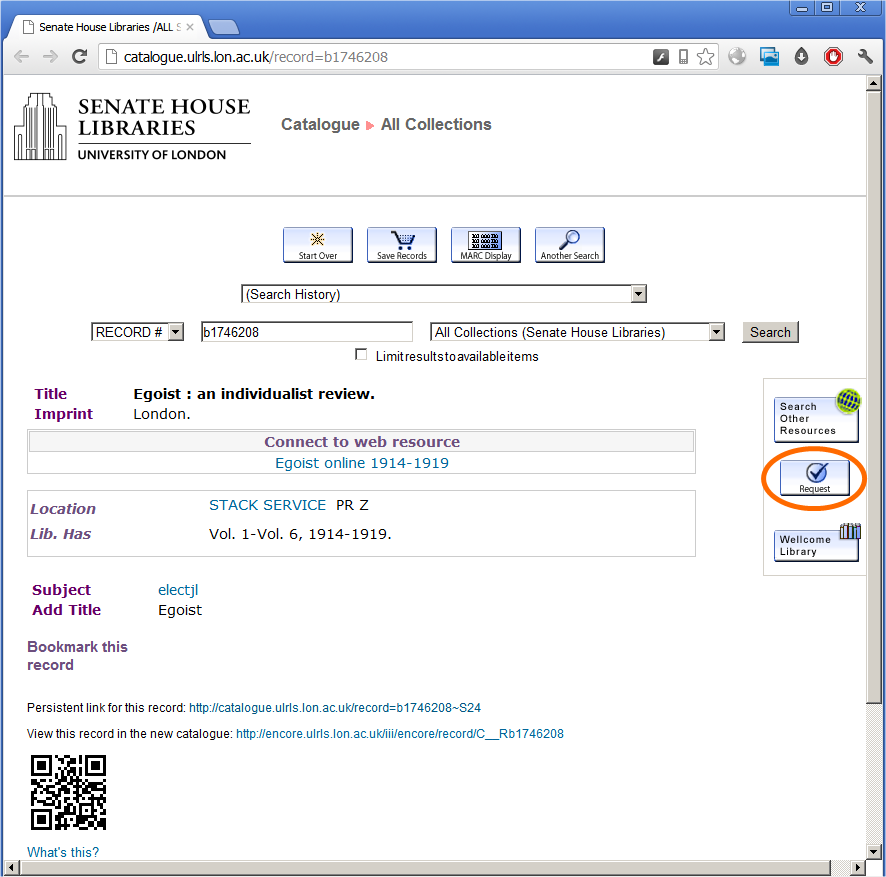
  2. If the record is a store location, build a link based on selecting the journal title, classmark, and the system record number from the bibliographic record. What is actually rendered on the page is a link using the same icon as we use for other types of online requesting:
Link from the WebPAC record to request a store journal, using Pathfinder Pro (circles in orange).

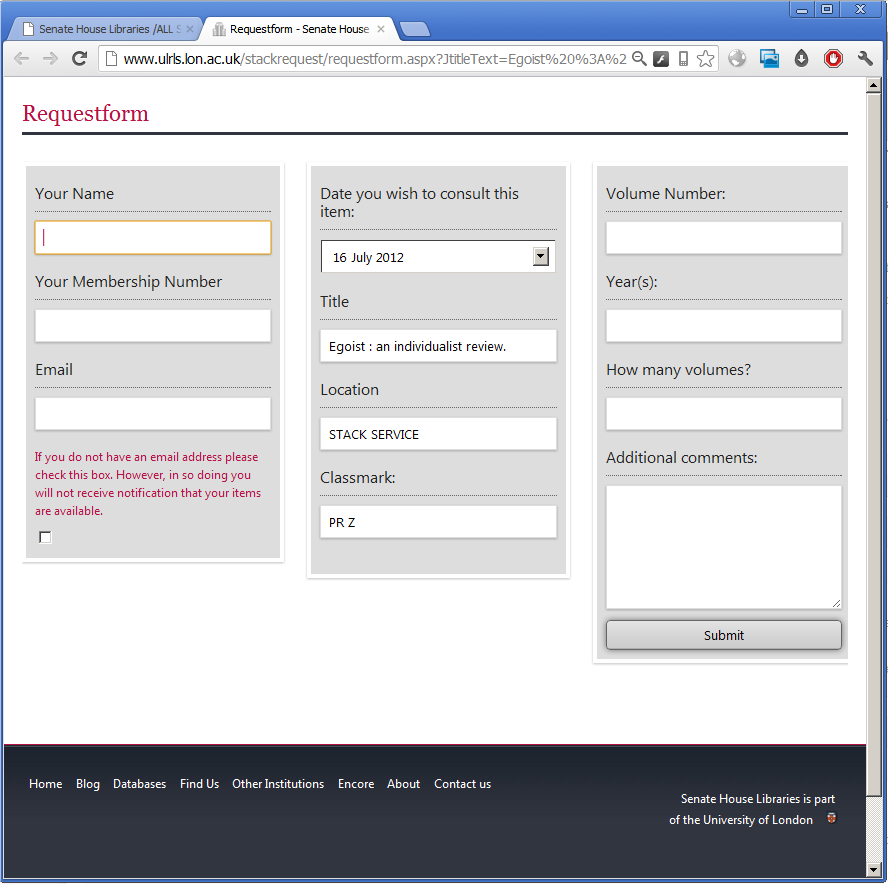
This generates a link to our online request form:

http://www.ulrls.lon.ac.uk/stackrequest/requestform.aspx?JtitleText=Egoist%20%3A%20an%20individualist%20review.&JlocationText=STACK%20SERVICE&JclassmarkText=PR%20Z&JbibText=b1746208a

Which leads to a neatly pre-populated form:

The problem with Encore

The thing that prevents this working in the new catalogue is Encore lacks the Pathfinder Pro “Bib Table” which allows you to place links on the record display itself. In the screenshot above the Bib Table is the space on the record that contains three buttons, including the store request button circled in orange.

This is a problem as many Innovative sites have built services around this feature of Pathfinder Pro that include placing a link prominently on the bibliographic record.

Towards a solution for Encore

The latest Encore release 4.2 allows you to customise the Encore record display by including your own JavaScript. My presentation on this from the European Innovative Users Group conference 2012 with further examples is available:

I decided there simply had to be a way to insert a link to the store request form into the page using JavaScript…

  • Our first thought was using JavaScript to check if the record is in the store, then building a link to the request from by plucking bits of metadata from the page. This was a non-starter as the structure of the rendered Encore page is not semantically sound enough to work with in this way.
  • Second thought was to use an Ajax call to scrape the record display of the classic WebPAC which would be easier to work with. This isn’t possible as Encore and the WebPAC run on different Web servers so you run into the same origin policy. And no, you can’t set up a proxy server on your Encore server to work around it.
  • Third thought was using a Web application with a dedicated screen-scraping library that that could pull the metadata from the classic WebPAC or Encore. We’d link to this from the Encore record display and allow it to direct the reader’s browser to the populated request form. This is almost what we implemented. Read on…

How to do it

Building a link out from the Encore catalogue is simple. The JavaScript for the Encore record is available as a Pastebin for easier reading.

What this will do:

  1. Get the system record number. The simplest way I’ve found to do this from the page itself is use the document.URL which contains the record number.
  2. Check to see if a div exists with ID toggleAnyComponent. Not that you’d know it from the name, but this div is rendered only if there is an attached holdings / checkin record which means we’re dealing with a journal record.
  3. If if exists, check to see if the div matches a regular expression for the string “STACK SERVICE”.
  4. If it does match, create a link out to our Web application and append it to the existing customTop div.

This link out appears in this form:

http://www.ulrls.lon.ac.uk/stackrequest/parse.aspx?record=1746208

1746208 is the system record number for Egoist, minus the leading ‘b’ and trailing check digit.

Web application for screen-scraping

The real work is carried out using a Web application written in ASP.NET by my team member Steven Baker. Steve used the Html Agility Pack which is a library for .NET ideal for scraping Web pages. Of course, you can use your favourite language to accomplish the same thing.

Scraping from the Encore or WebPAC record display is a complicated business and how our library has named our various locations and classmarks was not helping.

So instead of scraping the page directly and including lots of different tests to deal with the various oddities found in the markup, it’s much simpler to scrape the WebPAC record display and pick out the div containing the link rendered by Pathfinder Pro.

This link already has the metadata required for the store request form so it’s then just a matter of using this URL to send the Web browser on their way to the request form.

The first step is to load the classic WebPAC page using Html Agility Pack. The link from Encore provides the system record number to generate a link to the WebPAC screen in this form:

http://catalogue.ulrls.lon.ac.uk/record=b1746208

The Pathfinder Pro wblinkdisplay div from the classic WebPAC looks like this for the example of Egoist : an individualist review:

<div class="wblinkdisplay">
<form name="from_stack_service159_form">
<a href="" onClick="javascript:loadInNewWindow('/webbridge~S24*eng/showresource?resurl=http%3A%2F%2Fwww.ulrls.lon.ac.uk%2Fstackrequest%2Frequestform.aspx%3FJtitleText%3DEgoist%2B%253A%2Ban%2Bindividualist%2Breview.%26JlocationText%3DSTACK%2520SERVICE%26JclassmarkText%3DPR%2BZ%26JbibText%3Db1746208a&linkid=0&noframe=1');return false;"><img src="/webbridge/image/request.gif" border="0"></img></a>
</form>
</div>

You can see the URL Pathfinder Pro normally redirects the Web brower to. The next steps are:

  • Select the div with class wblinkdisplay.
  • Cut out the URL based on using “resurl=” and “‘)” at the start and end of the URL to get the indexes needed.
  • URL-decode the resulting string.
  • Redirect the Web browser to that URL.

In live use, this is so fast that the end user doesn’t realise anything is happening in between clicking the “Request from Store” button in Encore and getting to the request form itself.

Comments on this approach

There are several advantages to handling Pathfinder Pro and Encore integration this way:

  • The work to pick out metadata from the record has already been done in Pathfinder Pro and doesn’t need re-implementing.
  • This will be easy to extend to other store journals, or if journals move from open access shelves to the store. We only need set up a new location in Pathfinder Pro and it’s reflected in Encore as well. We’d have to do this anyway to enable online requests in the classic WebPAC.
  • This approach isn’t specific to journals and could be used to put any links generated by Pathfinder Pro into Encore.

However, this isn’t a complete solution as it doesn’t just give you the Pathfinder Pro Bib Table in Encore. This is what we would really like and what we have asked our software supplier for. That said, if you can pick something unique out of the Encore record to test for then you can link out from Encore in a way that replicates the behaviour of the linking in classic WebPAC with Pathfinder Pro.

Please do contact me with any questions or your thoughts, or leave a comment below.

The anti-social catalogue – at Library Camp Leeds

On Saturday 26th May I attended Library Camp Leeds (libcampLS), a regional library unconference hosted by Leeds City Libraries. The conference took place on a beautiful sunny day at Horsforth library.

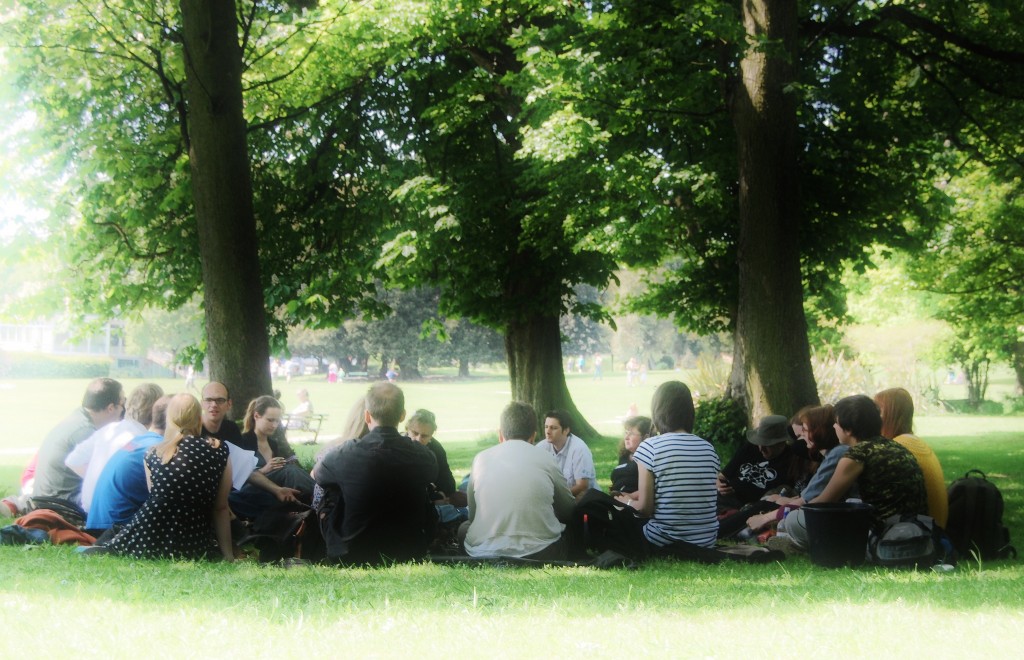
In a masterful move by the organizers we decamped to nearby Hall Park for the afternoon sessions which meant the session I had pitched on library catalogues took place ‘en plein air’. The unconference style made this easy to accomodate though there were some downsides, notably a dog that turned up and dug into Dace‘s salty cheese sticks just as the session was getting started…

Dog joining in with ‘cake camp’, photographed by Dace Udre, license CC-BY-NC.

The anti-social catalogue

Session underway, photographed by Kev Campbell-Wright, license CC-BY-NC-SA.

What is the next-gen library catalogue?

I opened by outlining what we mean by a “discovery interface” or “next-generation library catalogue” to give us some grounding. Then I gave a quick outline of the failure of current library systems to be “social”, that is, how they don’t facilitate social interactions.

I paraphrased from Sharon Yang and Melissa Hoffman’s article (2011) surveying library catalogues. I’ll repeat this below as I know it’ll come in handy in future. What makes something a next-generation catalogue isn’t very well-defined but we can say such a system will have many of these features, whereas traditional catalogues have few:

  • They provide a single point of searching across multiple library resources including the local bibliographic database, journal articles, and other materials.
  • The Web interface is modern and its design reflects that that found in Web search and ecommerce sites rather than traditional bibliographic retrieval systems.
  • They favour keyword searching via a single search box.
  • They feature faceted navigation to rework or limit search results.
  • They are tolerant of user error and provide “Did you mean…?” suggestions.
  • They feature enriched content drawn from sources outside the library such as book jackets, reviews, and summaries.
  • They feature user-generated content such as reviews and tagging.
  • They feature recommendations or suggestions for related material, which may be based on information held in the library system (e.g. circulation data) or elsewhere.
  • They feature some kind of social networking integration to allow for easier sharing and reuse of library records and data on these Web sites.
  • To facilitate this sharing, records have stable persistent links or permalinks.

What are the problems?

Some of the features mentioned above are social in nature, including user-generated content such as tagging and reviews, recommenders built from using circulation data, and integration of social networking sites. So “next-generation” implies a suite of features that include some social features, but not everything next-generation is such a social feature. Furthermore the underlying library management system and metadata are not likely to be too supportive of these features.

In practise social features like tagging and reviews haven’t really taken off in libraries and those of us using these tend to find low use among our customers. This is certainly my experience with tagging, enabled on our Encore catalogue at Senate House Libraries. It is not enough to have a reasonably large bibliographic database and a reasonably large membership then turn on tagging and expect something – the magic – to happen.

I do not think library catalogues are perceived as a social destination by our readers. However I think what prevents this is not that there is no wish by readers to interact in this way using our systems, but that we’re only just starting to make a serious effort to build features that encourage genuine social interaction.

This is what I mean by current catalogues being anti-social. However, I did like this alternative definition from Gaz:

Discussion

Note: attributions below are based on my notes from the day. If I’ve made a mistake please let me know.

The conversation was lively and varied and I was really pleased to facilitate a session where so many present wanted to contribute.

There was a general feeling the current technology isn’t there yet and implementation of social features on our catalogues do not encourage social interaction.

Luke explained catalogues built by vendors reflect the small marketplace offered by libraries and that technology in libraries tends to be quite far behind leading edge. He described the development of VuFind for discovery based on frustration with software supplier offerings – but one that required a willingness to invest in staff resource to develop and implement VuFind. This was done at Swansea University, Swansea Metropolitan University, and Trinity Saint David as a project – SWWHEP.

Luke mentioned something I have heard as a common objection to user-generated content in catalogues, the fear that students will abuse it and tag books with swearwords and so on. There was a similar concern raised that books written by academic staff might be rated down by students (with a cheeky suggestion added – “They should write better books”). Luke pointed out this has not proved a problem on the Swansea iFind implementation of VuFind (as it hasn’t at Senate House Libraries) because the feature is simply not being used. I thought that in some ways the feature being ignored is worse than readers actively disliking it…

Sarah gave an example of a ‘paper-based Web 2.0’ (my term) implementation where library members were given a paper slip to rate or review an item – which would then be keyed into the catalogue by staff!

Several campers made the point bringing in user-generated content from outside – such as Librarything for Libraries – could make a big difference as then there’s clearly something there to start with.

It was generally agreed building features that create good social interaction requires effort, it’s not something we can easily bolt on to existing systems that aren’t designed for this from the ground up.

There was agreement with Iman‘s point that for social features to become popular there should be an incentive for the customer. The customer should get value from the interaction, or what’s the point of doing it? Alongside this it shouldn’t take huge effort or require a great deal of work to be social. The concept of gamification as a way of providing that incentive was raised here.

Several campers gave example of where libraries know great a deal of information about our readers habits and actions, and could re-use this to enhance their experience of the physical or online library. The approach to social features on the catalogue that requires least effort are those interactions that happen by you doing what you would normally do anyway. For example borrowing and returning books to generate recommendations based on circulation information.

One problem was raised about emphasising top loaning items from the collection in that this could become self-sustaining: an item remaining popular because it is on that list. (At this point I wondered that I probably couldn’t make our top-loaning author Michel Foucault any more popular if I tried…)

Liz made a thoughtful point that the use of technology is important, that is how it enables us to fulfil the mission of the organization (the library, the university). We should concentrate on what’s relevant for our organizations. So: we need to be clear what we’re trying to achieve with these features and what the point of it all is. Technology used poorly for its own sake had already been raised, an example given being linking to an ebook record from the catalogue using a QR code: if you’re already online looking at the catalogue, why not just a normal hyperlink?

Rather than limiting ourselves to what other libraries are doing we should be thinking along the lines of features employed in ecommerce systems. Spencer made the interesting point that ecommerce systems he has worked with can build a much more complete picture of user needs and wishes with a view to offering them a tailored online experience. This is years ahead of anything libraries currently do.

Some more fundamental problems were raised about technology and libraries.

Linsey raised the idea of ’embarrassing IT’, that is IT provision that’s so bad we as information professionals are ashamed to offer it. Alison said the technology needs to be there to support new catalogues, or our staff and customers simply can’t make the best use of them. An example given by the group was of an older catalogue remaining popular versus a next-generation system because it’s faster to use on outdated computers provided by the library.

These problems aren’t minor. Feedback from the group was that our Web presence and user experience of our Web sites really influences users’ perception of our organizations. There’s a real need for us to do this well, not half-heartedly.

Acknowledgment

My thanks to Natalie Pollecutt at the Wellcome Library for helpful discussion about the concept of the ‘social catalogue’ ahead of libcampLS.

References

Yang, S.Q. and Hofmann, M.A. (2011). ‘Next generation or current generation?: a study of the OPACs of 260 academic libraries in the USA and Canada’, Library Hi Tech, 29 (2), pp. 266-300. doi:10.1108/07378831111138170

The Mnemosyne-Atlas: adding Pinterest to the library catalogue.

Why pinterest?

Last week I attended a talk by Phil Bradley at the Cilip in London AGM (a podcast of this talk Around the World on a Library Degree is available). Phil pointed out Pinterest as a particularly useful and interesting site to watch. I had not heard of this before so registered an account. Shortly after I noticed the Pinterest implementation at Darien Library.

Pinterest is a social networking site for sharing photos. Users organise items of media on boards – typically thematically or for a particular event.

I was immediately struck by the appearance of a full pinboard, it made me think of Aby Warburg’s Mnemosyne-Atlas. The Mnemosyne-Atlas was Warburg’s unfinished work, a series of plates (or boards) showing images from the classical period to Warburg’s present time. Alongside classical and renaissance images it included photographs, maps, woodcuts, advertisements, fragments of text, posters, and so on – all kinds of visual media. Warburg intended the boards to be accompanied by commentaries, but these were incomplete on his death in 1929 and only fragments exist.

Taken as a whole it is a summary of all of Warburg’s various interests. It has been compared with avant-garde photo montages in form but is something more, perhaps even a “visual archive of European cultural history” (Rampley, 1999). A photograph from an exhibition of Mnemosyne-Atlas plates is shown above. This is from a set on Flickr called aby warburg – the mnemosyne atlas.

Without expecting every user to be a scholar and cultural theorist of Warburg’s stature, I think there is value in supporting linking our catalogue records to Pinterest as it will allow users to relate them to other images and construct different meanings from them.  I feel it’s especially appropriate for Senate House Libraries which includes the library of the The Warburg Institute.

What is different about Pinterest is it makes creation of ‘vision boards’ easy – many sites now support pinning an image to Pinterest, and there are smartphone apps allowing you to pin anything you can photograph.

How to do this in Encore

At Senate House Libraries we have testing a beta version of the next release of our next-generation catalogue (or discovery interface), Encore. Caution! Everything described below links to a beta version of our catalogue that is not yet finished.

Adding a “Pin It” button is made possible by the ability to insert your own Javascript on the bibliographic record display of the new version of the catalogue. To be able to pin a catalogue record to a Pinterest board at minimum we need an image and a link to associate with it; a description of the image is optional. In this case the image is of the book jacket.

Here’s the Javascript to accomplish this, mind any line wrapping and WordPress oddness if you copy and paste it.

<script src="//s7.addthis.com/js/250/addthis_widget.js" type="text/javascript"></script>
<script type="text/javascript">
(function() {
var azImageDiv = document.getElementById("imageAnyComponent_0");
if (azImageDiv) {
if (azImageDiv.width>1 && azImageDiv.height>1) {
// key is a variable Encore uses for checking Google Books. It contains 'ISBN:' plus an ISBN10.
var azAsin = key.substring(5);
var pinterestDiv=document.createElement('div');
pinterestDiv.innerHTML = '<span class="bibInfoHeader">Pinterest</span><div class="addthis_toolbox addthis_default_style" ><p>' + '<a class="addthis_button_pinterest" pi:pinit:url="https://encore.ulrls.lon.ac.uk/iii/encore42/record/C__R' + recordid + '" pi:pinit:media="' + 'http://images-eu.amazon.com/images/P/' + azAsin + '.01._SCLZZZZZZZ_.jpg"' + ' pi:pinit:layout="horizontal"</a></div>';
document.getElementById("customBottom").appendChild(pinterestDiv);
}
}
})();
</script>

Commentary

The challenge is to ensure we only render the Pin It button when we’re confident we have a book jacket image.

First step is to get the imageAnyComponent_0 div and check the size. This div contains the jacket image on Encore and is put there by the catalogue. Amazon returns a 1×1 pixel GIF if it has no jacket to offer, so if the image is larger than this it is probably a jacket image. Having the image is key: if we don’t have it we render nothing.

Assuming we have a jacket image I use the Add This to insert a Pinterest button which will pin a larger version of the jacket image and a link to the catalogue. Add This makes it very easy to deal with various social media buttons with minimal effort, plus it includes analytics information allowing us to judge use of these services on the catalogue. I recommend it.

Getting the ISBN turned out to be easy as the vendor’s Javascript for checking for Google Books previews already declares a variable key containing ‘ISBN:’ plus the ISBN-10 of the book.

Result

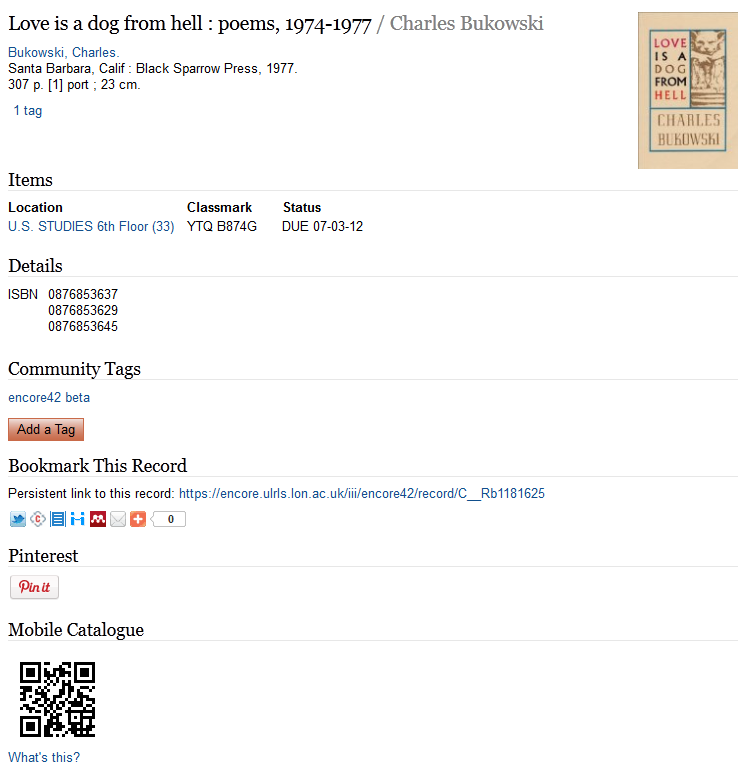
Here is how the the Pin It button appears in Encore:

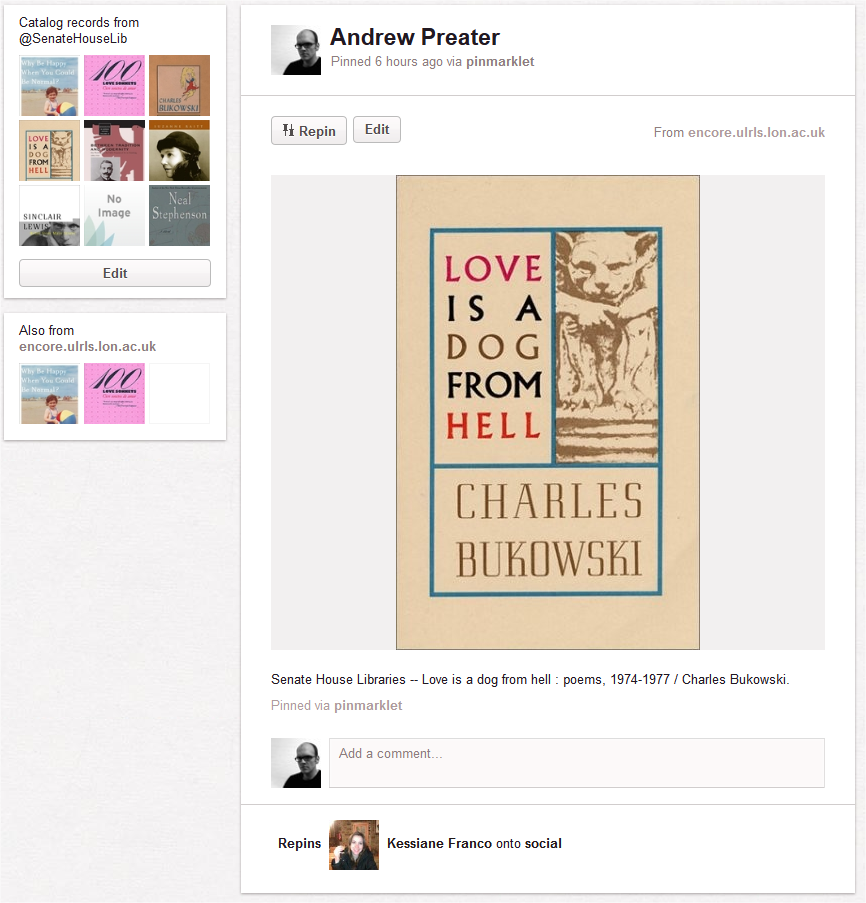
If you use the Pin It button, it results in the creation of a pin like this, which can be found on my (testing!) board Catalog records from@SenateHouseLib:

Problems

I think this is a satisfactory start: comments, improvements and criticism welcome (but especially improvements).

First problem is Add This doesn’t seem to support passing a description for the pinned item. To make sharing as “frictionless” as possible I wanted to the add part of the page title as a description, for example: Senate House Libraries — Love is a dog from hell : poems, 1974-1977 / Charles Bukowski would be fine, and the Pinterest user can edit this during pinning. I added this manually to my pin above. Based on the syntax for the other options above it should be: pi:pinit:description=”description” but that doesn’t work.

Second problem is Amazon images doesn’t support ISBN-13, only ISBN-10. However the Encore catalogue will use the first ISBN that appears in the catalogue record which might be an ISBN-13. Converting from ISBN-13 to ISBN-10 is not a complete solution as although you could pin the item, you won’t see the jacket image in the catalogue in the first place.

Photo credit

Mnemosyne-Atlas boards photographed by Flirck user dzsil, license CC BY-SA.

References

Rampley, M. (1999). ‘Archives of memory: Walter Benjamin’s Arcades project and Aby Warburg’s Mnemosyne Atlas’, in Coles, A. (ed.) The optic of Walter Benjamin. London: Black Dog, pp. 94-119.

Grouse about your next-generation catalogue – LibCamp@Brunel

A journey to the the wild wild west (of London)

On Saturday 28th January I attended LibCamp@Brunel, a library unconference generously hosted by the library at Brunel University in Uxbridge. I’d not been this far west in London as a destination before and on arriving I was pleased to recognise the tube station at Uxbridge as one of Charles Holden’s designs, which I took as a good omen for the day.

At the opening introduction and pitching, I pitched a session about staff perception versus library user perception of  next-generation library catalogues. As the unconference attendees were by and large library workers, I also wanted to invite everyone to come and grouse about problems they’d had with these systems. And let’s be honest, “Grouse about your next-gen catalogue” is going to be fun.

I had modest expectations for this session but it was very well attended, so much so our allotted space was too small and we had to move somewhere roomier. As I was facilitating I couldn’t live-tweet the session and following a few requests from people who couldn’t attend I decided to expand on the points made to give you a flavour of the discussion.

Perceptions of the catalogue

For some time I’ve been trying to understand problems readers have with the catalogue, and had wondered if it was possible to generalise this to talk about staff versus reader perception of Encore and next-generation systems. I hoped we could work towards this in discussion. As well as Encore, Aquabrowser, VUfind, and Summon were mentioned in discussion.

We’ve come a long way. I expected I would have to define next-generation catalogue in the session, but I was delighted when one of the graduate trainees present explained what I call next-gen was simply what she expected from a normal library catalogue. I had to give a really quick potted history of four generations of catalogue interfaces. (This is how to make your systems librarian feel old…)

I explained our experience of implementing Innovative Interfaces Encore at Senate House Library, and particularly how different I have found the perspectives of the library staff versus our readers. To be clear, my colleagues were almost entirely positive towards the new catalogue. I was pushing at an open door implementing a catalogue that offers a much better experience to readers used to using modern Web sites compared with the previous catalogue, relatively little changed since the 2000s.

However, I think it’s important to answer criticism and deal with objections as there could easily be problems I’d overlooked, and there’s a need to have these arguments as one step in bringing people with you.

Andrew, you can’t implement without feature x

In the early days pre-implementation I heard various objections to Encore along the lines of it being feature-incomplete compared with the previous catalogue. Some of my colleagues were hopeful that it would be possible to put off implementing Encore on this basis: we should wait until the next release, or the next-plus-one release, where these issues would be resolved…

It is correct that the new catalogue:

  • Doesn’t generate any left-to-right phrase indexes as our old catalogue did. Everything is indexed as keywords.
  • Doesn’t deal with classmarks for most of our multitude of classification schemes at all. At all. It doesn’t index them as classmarks and doesn’t allow you to browse by classmark.
  • Has fewer options for presenting a ‘scoped’ view of the catalogue limited to just a particular library or collection.
  • In the version we launched with, didn’t offer an advanced search with pre-limits and didn’t support boolean operators at all. (This has been added since.)

Having already done some user testing of the new catalogue I was reasonably confident none of the missing features were a show-stopper for implementation. If there were problems for some readers, we had a simple solution: allow everyone to continue using the old catalogue in parallel to the old one.

One of the Library Campers had pointed out in advanced this is an unusual approach. I explained further in discussion this was partly by necessity as the ‘patron’ features – the ability to log in to view your loans, place a reservation and renew loans – were still based in the old catalogue anyway.

I was asked about how we make sure readers find and use Encore. To drive reader uptake of the new catalogue I wanted to offer Encore as the default option on that places that really matter to us – on the Senate House Library homepage and on the old catalogue homepage. The latter uses some JavaScript to redirect your search depending on what options you select, but if you keep the default ‘Quick Search’ you get Encore. It was important to me that by following the path of least resistance readers would end up with the new catalogue.

I have said before and I stand by it: if you want to buy and implement a new system you should have the courage in your convictions and implement it properly. It amazes me to see libraries that offer their new discovery interfaces as an “alternative search” that can be ignored, or that requires special effort to find and use. I do see the value in doing this during a public beta test or preview, as the British Library did with Primo (branded as Explore the British Library), but absolutely not when you’ve made it live.

As of January 2012 we see slightly more use of the new catalogue in terms of visits, ~56% of the combined total based on Google Analytics data (I said ~50% based on data from Q4 2011 in the session). I consider this a reasonable start.

In the eight months since going live with the new catalogue several types of problem have emerged with Encore.

Longer term: how staff use the catalogue

It’s surprised me how many unusual uses of the old catalogue interface our staff have built up over time and the extent to which the catalogue has taken on functions I wouldn’t expect. For example, making use of the way classmarks are indexed to produce a list of everything from a particular classmark, particularly useful for Special Collections where the classmark might be used to describe what collection something is in. Or a need to produce a list that represents everything related to some sub-set of our catalogue – that is, a search strategy that you can be confident represents 100% true positives!

Much of this has been presented to me in good humour in a playful spirit of showing me how Encore can be “beaten” by a particular use case.

There are uses of the old catalogue that are simply impossible in the Encore catalogue, but my answer is first they don’t tend to represent realistic use cases our readers make, second they can more or less easily be moved to the staff client for our library system. Apart from Encore, Katharine Schopflin and Graham Seaman discussed how next-generation systems can have problems with known item searching and in attempting to present a search interface biased towards too much towards browsing and subject searching can be actively unhelpful when you have specific items in mind. I explained I think Encore is quite good for known item search, in particular the way it prioritises exact hits from MARC field 245 $a, my favourite examples are journals like Text and Agenda.

Generally I don’t think we should aim every discovery tool only at our most expert users, information professionals with great experience with our collections, when they have working alternatives available. I explained in response to a question there is no staff-specific view of Encore if you sign in using a staff account. I think this is right and proper from a “dogfooding” point of view, but I confess I daydream about a catalogue that is this flexible enough to offer a different interfaces with different features for novice to expert as required…

Longer term: you need to sort out your metadata

It’s become a truism that because next-generation systems make better use of our bibliographic data they force us to sort out existing problems with our metadata. We’ve certainly found our fair share of these problems since launching Encore, but not all of them are fixable.

The first we’ve tried to address is the way different types of material were described in our catalogue, the combination of print monographs (er, books) and print periodicals (um, journals) into a single material type termed “printed material”. Cue amused smiles from the Library Campers! Since then we’ve split them into books and journals as I explain on a blog post on our Encore blog – ‘Helping you find print journals more easily’.

The general problem is Encore can only act on the metadata it has available, but realistically you won’t always have time and money to do the work required to make it good. Encore does useful things like provide facets based on geographical names in your subject headings, or dates of publication, or languages. The problem is the data being missing or coded ‘undetermined’.

We know there are some very good items in our collection that are not findable during subject searching by readers because they have a record that’s not very good. Graham Seaman mentioned a problem in Summon in the way dates can be described in different ways, understandable by humans but not machines. For example you could refer to things from the same time period as ’16th century’, ‘1500–1525’, or ‘Renaissance’ and so miss out on relevant items.

These are problems that existed with our old catalogue but which the next-generation catalogue brings into sharper relief.

Towards ethnographies of the next-gen catalogue user

This is the third post in a series exploring user understanding of next-generation catalogues:

Talk

This is posted to coincide with the ChrisMash Mashed Library event organised by Gary Green in London on December 3rd. I spoke about the outcomes of an investigation into user experience and understanding of the next-gen catalogue and next steps we’re taking at Senate House Library. Not very Christmassy I admit…

@preater's presentation on flickr
‘@preater’s presentation’ on Flickr by Paul Stainthorp, license CC-BY-SA.

Slides from this talk are now available:

My slides were kept deliberately simple – it was presented in a pub on a flat screen TV! Notes are included to explain things further. Please get in touch if you want to ask anything about this.

Starting point

We implemented Encore from Innovative Interfaces in June to run alongside and partly replace the older WebPAC Pro catalogue, also from Innovative. Our Encore instance is here; the search I used in my talk was ‘industrial workers of the world‘.

Ahead of implementing we didn’t have much idea about how library users would understand this type of catalogue, so for my masters dissertation I had a look at this using various qualitative methods:

  • Usability-test style cognitive walk-throughs, done almost as a warm-up but providing lots of interesting data. As an aside I think every library should be doing this with their catalogue – it is so quick and easy to do.
  • A semi-structured interview using repertory grid technique. This was very good for comparing what my participants really thought of each type of catalogue.

Key findings

To summarise very briefly:

A Web-like catalogue encourages Web-like behaviour

Putting readers in front of a catalogue interface that looks and behaves like a Web search engine results in behaviours closer to a Web search engine than traditional information retrieval.

By this I mean:

  • A tendency to scan and skim-read Web pages quickly, concentrate on titles.
  • A process of iterative searching based on using a few keywords and then reworking the search over again based on what’s found on the results page.
  • Trust in the relevancy ranking of the catalogue; an expectation that the catalogue should be tolerant of small errors or typos via ‘did you mean…?’ suggestions.
  • The tendency to ‘satisfice’, meaning making do with results that seem good enough for the purpose rather than searching exhaustively.
  • The view that a search queries are an ongoing process, not something that should produce a single perfect set of results.

Caution: this is based on coding qualitative data from nine people and is not intended to be absolute or apply to every user. I found strongly contrasting opinions of the catalogue with an overall tendency for younger readers to take to the new interface much more easily.

The method I used was inductive, that is developed from analysis of what I observed. I really did not expect this ahead of time.

Using our catalogue is an affective experience

I found there was a strongly affective or emotional response to use of our catalogue beyond what you’d think you might get from using a mere lookup tool. The response was about more than just the catalogue being pleasant to use or familiar from other sites.

This was very interesting because I do not see why a library catalogue should not be a joy to use. Why should library catalogues be a painful experience where you have to “pay your dues”? Even if we changed nothing else behind the scenes and made the catalogue more attractive, you could argue this would improve things because we tend to believe more attractive things work better because they’re more enjoyable. Here I am paraphrasing from Don Norman (2004).

Next steps

Usability testing gets us so far, but as I’ve said previously in an artificial “lab” setting it does not produce natural behaviour. That’s a problem because we don’t get to see the reader’s true understanding emerge. We don’t get to see how they really behave in the library when using the catalogue.

I went fairly far in comparing systems – WebPAC Pro versus Encore – but what anchored that testing was the old catalogue. Having implemented the new catalogue and positioned it fairly aggressively as the default interface I wanted to dig deeper and better understand how the catalogue fits in to the reader’s experience of doing research at Senate House Library.

Think about the experience of library use: the reader comes in and experiences an entire “ecology”: the physical building; print book and journal collections; e-resources; the library staff; our catalogues and Web sites. I wanted to better understand how readers experience the catalogue in this context rather than just thinking about it in systems terms as a tool for looking items up that is used with a particular rate of error or success.

Towards ethnographies of the next-gen catalogue user

What we’re going to do is borrow techniques from anthropology to do ethnography in the library. This means studying and observing readers in their habitat: as they work in the library and do their research.

The outcomes I want from this are fairly “soft”, based around our staff knowing the readers better. What I want to know is: how can the library better support our readers’ use of the catalogue and improve their experience of Senate House Library? This is fundamental: I think without better understanding our readers use of our catalogues, we can’t start to improve what we do and provide a better service.

Properly speaking this is more a case of “borrowing ethnographic methods” than “doing ethnography”. This is OK as the methods aren’t owned by one field of social science, as Harry Wolcott (2008) says they “belong to all of us”.

Practically, what want to do is use a battery of techniques including semi-structured interviews, observation, and close questioning to generate data that will allow development of theory from that data as it is analysed qualitatively. This is a grounded theory approach. The actual work will likely be small “micro ethnographies” done over a period of some months in the library.

Examples

In my talk I mentioned some examples of ethnographic research done in libraries, these are:

  • Investigating user understanding of the library Web site – University of North Carolina at Charlotte (Wu and Lanclos, 2011)
  • Looking at how the physical library space is used – Loughborough University (Bryant, 2009)
  • Ethnographies of subject librarian’s reference work – Hewlett Packard Library and Apple Research Library (Nardi and O’Day, 1999)
  • The ERIAL (Ethnographic Research in Illinois Academic Libraries) project which has produced various outputs and has an excellent toolkit telling you how to do it (Asher and Miller, 2011)

References

Asher, A. and Miller, S. (2011) ‘So you want to do anthropology in your library?’ Available at: http://www.erialproject.org/wp-content/uploads/2011/03/Toolkit-3.22.11.pdf

Bryant, J. (2009) ‘What are students doing in our library? Ethnography as a method of exploring library user behaviour’, Library and Information Research, 33 (103), pp. 3-9.

Nardi, B.A. and O’Day, V.L. (1999) Information ecologies. London: MIT Press.

Norman, D.A. (2004) Emotional design. New York, NY: Basic Books.

Wolcott, H.F. (2008) Ethnography: a way of seeing. 2nd edn. Plymouth: AltaMira.

Wu, S.K. and Lanclos, D. (2011) ‘Re-imagining the users’ experience: an ethnographic approach to web usability and space design’, Reference Services Review, 39 (3), pp. 369-389.