Management and leadership, a radical approach? At Radical Library Camp

Radical library camp

I recently attended, and helped to organize, a library unconference in Bradford. This was the first Radical Library Camp or #radlibcamp on Twitter.

There was some discussion pre-conference about the nature of a self-identified ‘radical’ unconference. I think the nature of unconferencing is already radical compared to formal conferences but what I thought made Radical Library Camp different was open space technology applied in a context of different issues and with knowledge of various issues and concepts already present with the attendees (or campers). In practical terms this meant sessions could hit the ground running with relatively little need to explain what we are about, and meant we could immediately dig into the issues at hand.

To me Radical Library Camp definitely still felt like a Library Camp event and ran along similar lines. It all went off very well. The venue, Bradford Resource Centre, was particularly welcoming and hosted us perfectly so many thanks to them.

For the event I had decided to try to talk less and spend more time listening and thinking about others’ contributions. However I couldn’t resist pitching something as I had recently been thinking about management and leadership and whether there could ever be a workable ‘radical’ approach, so…

Management and leadership session
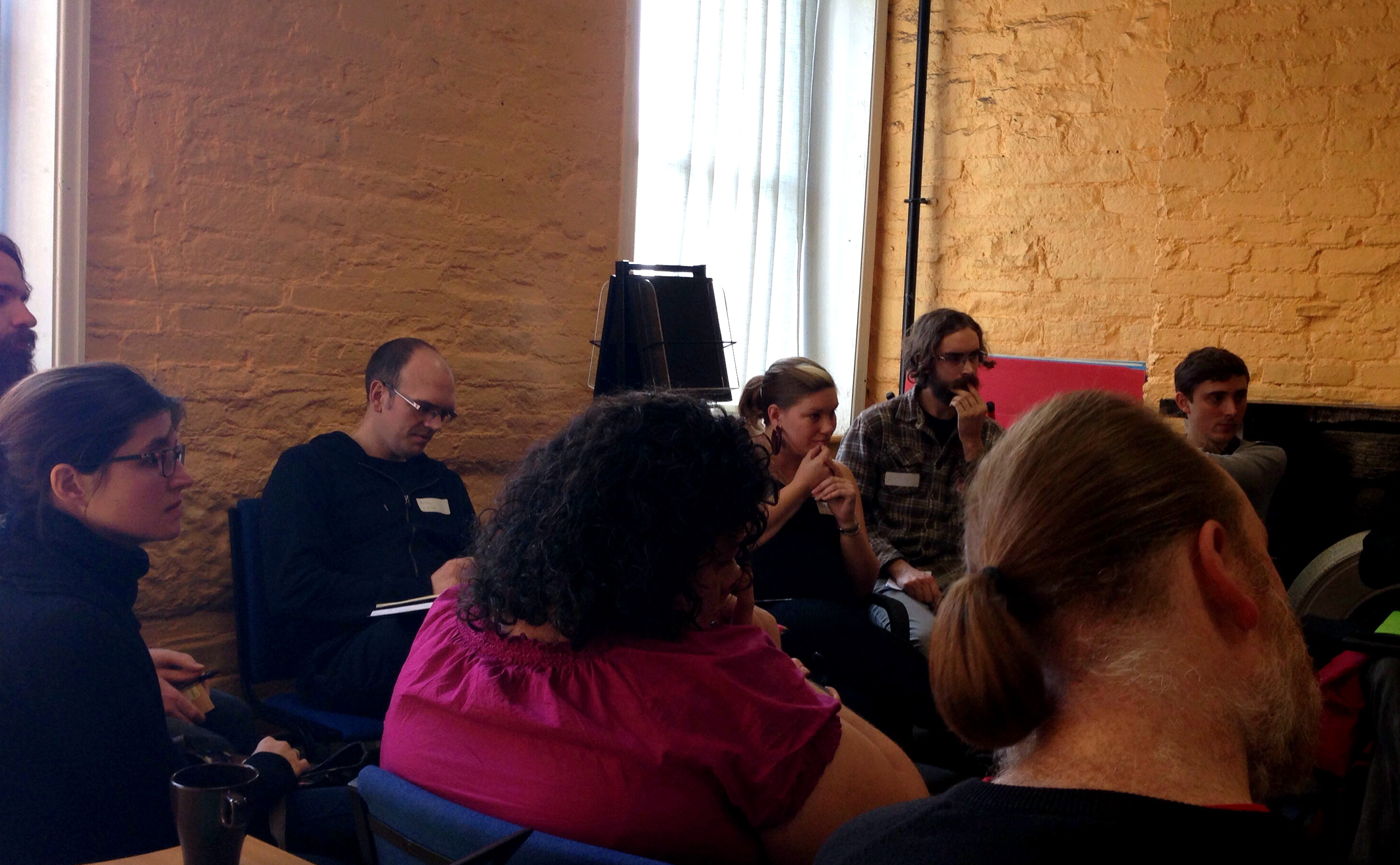
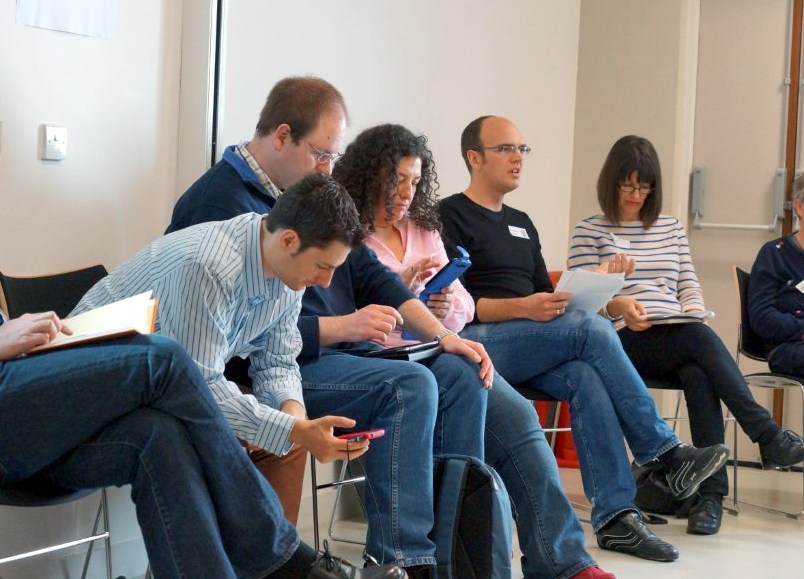
'Leadership and radicalism...' session, modified from a photopgraph by Ian Clark. License CC-BY-NC.
‘Leadership and radicalism…’ session, modified from a photograph by Ian Clark. License CC-BY-NC.

I had done some reading about this, mainly at the excellent Institute of Education library, but really I wanted to open the question to the group and see where discussion took us. To this end I posed some questions after a brief opener:

  1. Is there an approach to managing people in libraries that remains honest? And if you manage people how do you do it?
  2. Making the leap: if you move from a ‘clerical / technical’ role to a ‘management / professional’ role, what changes? Is this just about others’ perceptions?
  3. Is it possible to be ‘management’ without selling out? How do you handle this yourself?

I explained I had been thinking primarily about leadership, but that we could easily look at ‘radical’ in different contexts such as supervision, management, or leadership. I suggested looking more broadly to be inclusive, as often staff on lower grades have supervisory or management responsibility without perceiving themselves as ‘management’ but will face some of the same issues as senior managers.

Some brief definitions of the difference between these roles:

  • The supervisor’s job is directing and instructing
  • The manager’s job is to planning, organizing, and coordinating
  • The leader’s job is inspiring and and motivating

It seems much easier to pitch a radical approach to leadership than to management. It’s much easier to bring to mind approaches exemplified by leaders, for example in trade unions or politics, who take a bona fide ‘radical’ approach. The managing and supervising context is more difficult and on reflection I do not think we were able to develop answers much beyond a leadership context.

It can seem obvious or self-evident that libraries like other organizations need management to ensure they are efficiently organized and productive. Daniel Wren for example presents management as a quite natural thing that follows the evolution of human society:

As people’s conceptual ability has been refined through evolution, they have also refined their understanding of the art of arranging physical and human resource for guidance towards purposeful ends. We call this art management… (Wren, 1987 p. 11, italics in original)

From a very different angle Marx (1976 pp. 448-451) identifies managers and supervisors as ‘a special kind of wage labourer’ with a function made necessary by the need to maximize generation of surplus value and hence profit. Marx of course relates this function to class struggle and casts management as a function necessary to make wage labourers cooperate with each other under capital.

I also gave some context about new public management (NPM) from the contemporary public sector. NPM as a concept denotes broad government policies since the 1980s that aimed to make the public sector more efficient and effective, the idea being a market-oriented management style could be used to drive cost-efficiency for government. For the organization and workers this meant a shift from a bureaucratic approach based on state administration to a managerialist approach based on performance: from ‘state-regulated’ to ‘market-regulated’ (Ward, 2012 pp. 47-52).

Discussion

Personally I took two major themes or points from the session: if there is a radical approach to management and leadership it is based on both fairness as a manager and authenticity as a leader.

Several in the group raised the idea of changing things from the inside as a manager – the idea is similar to entryism in politics and was called such by one of the campers. This deserves credit as leaders are likely best placed with opportunity, power, and freedom to act to make improvements, and certainly to lead by example. One possible trap here would be overemphasising the role of the individual and thinking it’s down to the ‘heroic leader’ doing everything themselves that drives improvements.

A general point made was that we should seek good practice in management and leadership even if this isn’t ‘radical’, indeed much of it won’t be so. Examples given were communicating well, listening even if you cannot act on everything you hear, and involving staff to get input on decision-making. One point raised in the session and beforehand by Sarah on Twitter was that good management practice isn’t linked to left or right-wing political opinions.

Authenticity and fairness

Liz raised authenticity in leadership as a vital characteristic. This is about being authentic yourself as a leader, and also how you implement an authentic approach in your context as a manager. Goffee and Jones describe how leaders translate this into behaviour to demonstrate authenticity:

  • A consistency between words and deeds – the leader practises what she preaches
  • Presentation of a consistent ‘real self’, despite the need to play different roles to different audiences
  • A sense of the leader being comfortable with her origins

These bullets are a paraphrased summary from Goffee and Jones (2006 pp. 16-17).

It doesn’t follow that the authentic leader is one everyone always agrees with or who is universally liked by staff, and the point was reinforced in discussion that it’s not possible to please everyone all the time.

Liz also raised the issue of being fair and being seen to be fair as a manager in treatment of staff as important. This means for example dealing with issues in a way that gives fair treatment to all and not playing favourites. To make one distinction here I would emphasize a difference between fairness and justice. The outcome of a situation may not be considered subjectively fair by everyone concerned, but from a management point of view it had better be just.

For me there was an outstanding question about personal responsibility and ensuring our personal values and professional ethics are congruent with our work and the values of the organizations we work for. One tweet commenting on the session discussion in this spirit from Dave:

One point raised from the audience here was this is a very difficult proposition for those in a situation of precarious labour. An example given was you may find you have no real choice but to work in an organization that doesn’t match your own ideals or professional ethics because there are no other jobs to move to. Points of principle rub up against real-world responsibilities like paying the rent or mortgage.

Stepping back from this very immediate example, more broadly from the point of view of managers and staff there is an issue here about the limits on what we can do personally to affect change. For example perhaps we dislike hierarchy, but we work in organizations that represent classic Weberian bureaucracies which rely on hierarchy to get things done. There is a balance here between going too far and selling out and being ineffective due to failing to engage with the cultural norms of the organization.

Reflecting on this further I think the key issue in authentic leadership is knowing where and how much to compromise to create progress without undermining our personal morals and professional ethics.

References

Goffee, R. and Jones, G. (2006) Why should anyone be led by you? Boston, MA: Harvard Business School.
Marx, K. (1976) Capital: a critique of political economy. Volume 1. Harmondsworth: Penguin.
Ward, S.C. (2012) Neoliberalism and the global restructuring of knowledge and education. London: Routledge.
Weber, M. (1947) The theory of social and economic organization. New York, NY: Free Press.
Wren, D.A. (1987) The evolution of management thought. 3rd edn. New York, NY: John Wiley.
Practical suggestions for running your own Library Camp

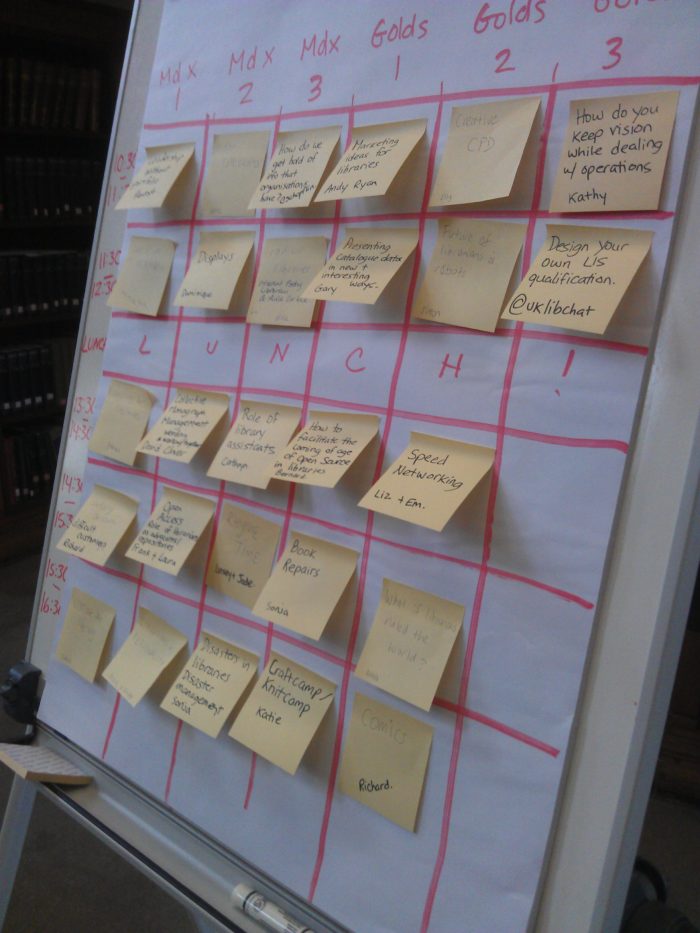
Library Camp London board following pitching.

So you want to run your own Library Camp unconference?

This is meant as practical advice in contrast to my reflective post.

I realized doing this was feasible when I attended a “Run your own Library Camp” session at Library Camp UK 2012 (blog post summarizing this from Carolin). With experience it’s fair to say the organizers of that session were modest, and underplayed how much work went into their events. It is quite some work – but less than organizing the equivalent size traditional conference would be. Here are my thoughts grouped into general themes.

Inclusivity

Alongside several other great ideas, Anne encouraged me to reserve places at Library Camp London for students. This meant they had the best possible chance of attending as they could be certain of a ticket and arrange travel more cheaply in advance. I expected better uptake if this came from lecturers themselves, so I circulated an advert for the unconference to colleagues at UCL, City University, London Met, and Brighton. I was able to sell out the student tickets in a day.

I wanted to ensure Library Camp London was emphatically cross-sector in outlook. I made contact with our local public library authority, London Borough of Camden, to ask about co-hosting. I had several reasons for doing this:

  • To widen participation and facilitate discussion and sharing between those from academic, public, special libraries, and non-library backgrounds.
  • At previous regional camps I’d noticed a tendency for attendees to be weighted towards the sector of the hosting institution.
  • To demonstrate how the University of London is engaging our colleagues beyond academic libraries. (We’re doing it; we need to demonstrate it too!)

I also contacted colleagues at special libraries to advertise the unconference internally, and spoke at a Camden Libraries Network meeting held at the Weiner Library to promote the event.

Encouraging contributions

Unconferences subvert the traditional conference approach as they are participant-driven and lack top-down organization. It was essential to maintain this spirit at Library Camp London.

However, I knew I could build interest by doing some groundwork. In practical terms this meant encouraging library folk to attend and pitch (this is easier over a drink), and talking to people I thought would have something interesting to contribute. Even those who could not make it in the end provided useful ideas, suggestions, and helped promote the event but talking to others. Additionally, I felt asking others to facilitate who hadn’t done so before was actively encouraging their development. Sometimes people just need a little nudge.

I was pleased we could provide a setting and importantly the technology needed to enable a live uklibchat on the day. I love the idea of a live uklibchat at an unconference but to be successful it is very technology-dependent so that aspect had to work perfectly – this means preparation.

Eventbrite

We had fairly complex requirements for ticketing and a waiting list and Eventbrite met these. It’s free and works.

The only thing I missed is a way of emailing the waiting list as you can with ticket-holders. What I did was export the waiting list to CSV and use that as the basis for a mail-merge.

On the day we needed effective ticketing as the library was open as usual. We used the Eventbrite Entry Manager app for Android to check-in on the gate. This was speedy and efficient with two or three of us present all the time. Eventbrite allows delegating limited access to your account to another user, so they can just do check-ins for an event without having access to the rest of your account.

I left a printed delegate list at our membership desk for latecomers, along with an example printed ticket.

Overselling

It’s sensible to over-sell tickets for a free event, the question is by how much. I found out other Library Camps have had drop-out rates between 10-25% but that has been highly dependant on things like transport problems on the day. We thought our central London location would lead to fewer drop-outs so I spent some time working out the limits of what we could do with our space. 150 library campers would have been too many but 120-130 would have been OK, I reasoned. I assumed a drop-out rate of about 10-15%.

We had 139 delegates on Eventbrite and checked-in 111 on the day. If I ignore those who cancelled after the point I could reallocate their tickets but did still cancel, it was 16% drop-out.

It was helpful to do several mailouts using Eventbrite ahead of the event to remind people who could no longer attend to release their tickets. Email is effective at this; asking on Twitter doesn’t seem to be. Richard had warned me about it, but I was still surprised how many people cancelled one day before the event. I was ready to go with a mail-merge for last minute ticket requests using my Eventbrite waiting list.

Unsure of final numbers, I found it very useful to have a ‘spare’ session location. I had planned three sessions in one room and two in another, but knew we could fit three sessions in both rooms if needed. We had pitches to fill those three spaces in both rooms for two of the morning sessions, so having an extra space pre-arranged was helpful.

Staffing and assistance

Having staff from Senate House Library available on the day made a huge difference to the smooth running of the event. In particular, my colleague Esme Stephens made strong contributions to several sessions alongside being a whirlwind of activity helping with the practical organization. If you can find one, have an Esme helping you.

Offers of help from others were appreciated, but unless it’s people involved from early on I’d recommend only accepting offers where you have a specific and defined job in mind. What I needed on the day were people to respond immediately to requests and take action. This would be very disruptive and somewhat unfair for someone expecting to attend the conference who had innocently offered to lend a hand.

Details

Details matter a great deal – they all add up to the overall experience of your venue and event. If you miss something it will be talked about in public and you’ll be apologizing for it.

  • Wifi / wireless absolutely needs to be working.
  • Make sure signs – including things like direction arrows – are printed correctly and ready to go before the event.
  • Make sure each session has flipchart paper and more than one pen.
  • Water bottles are better than glasses of water for carrying around a library. I accidentally ordered only fizzy water rather than a mix of fizzy and still which was an oversight.
  • We moved a lot of tables around for the event which uncovered carpet that needed a clean. Our cleaners were in there hoovering before I’d even asked.

Noise

I thought the choice of two big rooms was a positive one given experience from other unconference events that big rooms allow freer movement between sessions than small ones. People are uncomfortable getting up in front of everyone to leave a small room through a door/ Unfortunately it meant loud sessions disrupted quieter ones. The speed networking event and rhymetime sessions were quite loud – these were were both excellent sessions and brilliantly facilitated, but louder than the sessions next to them:

Ideally I would have provided separate space for especially quite or noisy sessions to be more contained. I was limited by the spaces actually available in the library though. I had initially planned to use different rooms including smaller spaces, but that would have made for a much smaller event.

What I learned from organizing an unconference

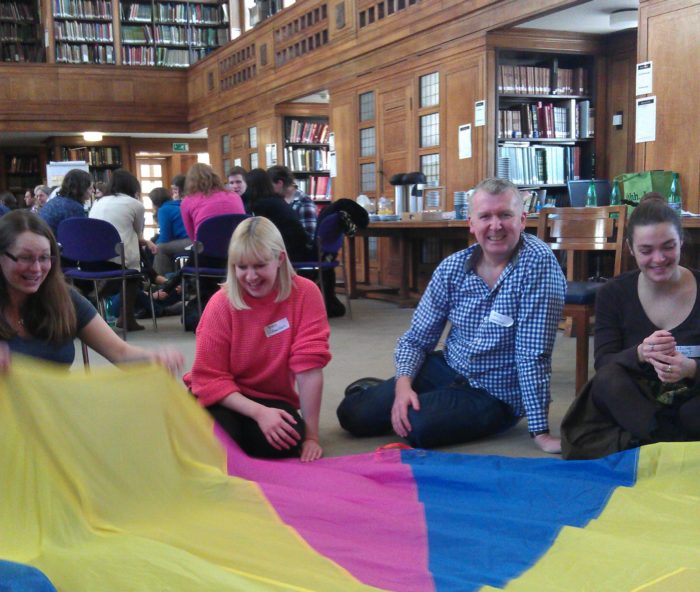
Jodie, Rosie, David, and Céline during the rhymetime session.

Reflection

Late last year in Somers Town Coffee House, Euston, I pitched the idea of running an unconference at Senate House to a group of librarians. They not only wanted to see it happen, but several of them including Gary offered to help right away. The idea itself wasn’t new as my colleague Les mooted running an event at Senate House after Library Camp Brunel

I’d imagined using the traditional, historic reading rooms of Senate House Library as a venue for hosting a fresh, modern conference – a combination of the traditional and the contemporary. I feel this is exactly what we managed to deliver.

Our location and size meant I thought I could make the unconference a bit bigger than regional library camps tend to be. We had 111 library campers including people from beyond library land, a very broad mix of sessions, and a delicious savoury lunch – although some subversives brought cake along too.

The highlights of the day for me were:

  • The rhymetime session run by Linsey and Jodie in our Middlesex South reading room had a transgressive feel and took most of us well out of our comfort zones. Informative, funny, and so different from anything I have seen at a conference before.
  • Sara‘s agreement to bring The Intinerant Poetry Library made for a really special part of the event for me. I was already a ‘Valued Patron of the Library’ and having a radical library like TIPL operate inside my own library has been a dream for some time.
  • Getting out of my comfort zone with hosting and organizing and event rather than just speaking or facilitating was very rewarding. I was scared at the thought of addressing 100+ library campers before pitching, but having done this once I know I can do it again and it will get easier and more natural.
  • Importantly for me, being able to make a contribution to other’s development by providing an event based on Open Space principles that allowed discussion to develop in an engaging and non-hierarchical way.
  • Lastly, I discovered Liz and Katharine both have truely awesome shushing ability.

Comments like these made my day:

Elly said:

Library camp was not only invigorating, but also liberating. All too often we get fixated on the idea of CPD in order to develop within our current role, essentially to get “better” at our current job. However, Library camp being free, and on a Saturday, meant that the day was solely for me as a professional.

The few days before the unconference were non-stop and the Saturday running the conference was intense. I promised myself I would not host anything this exhausing again too soon.

How come? We’d been removing desktop computers from our reading rooms gradually as we phase in Everyware mobile device lending, but the last PCs weren’t removed until Friday morning. On the Friday I was whizzing around Bloomsbury on a Boris bike looking for last-minute supplies – plastic knives and forks, Sharpie pens, labels, and paper napkins – as well as dealing with a slew of cancellations, getting furniture moved around by our portering team, and printing the signs and leaflets for delegates. Anything and everything that anyone else did to help was enormously appreciated.

On the Saturday morning I had an enormous feeling of relief when everyone started rolling in as expected, and made their way smoothly from cloakroom to lunch table to tea and coffee. During a lull Richard explained, “You’ve done it”, meaning the hardest part of organizing was over. He was right about this.

What next?

Following Library Camp London I’ve reflected on some of the limitations of an unconference for a generalist library audience. If you’re a specialist and want to present on something quite specialist, you may only be able to scratch the surface of what’s possible in discussion. Of course it is wonderful and encouraging that people come to learn and ask questions – indeed, that’s what I asked for during pitching at the beginning of the day. It was really interesting that a discussion notionally on Open Source library systems progressed onto talking about the value of children learning programming and the impact of Raspberry Pi, for one!

Having said that, I’ve realized there would be space for a library unconference in London with a technical or system focus. This could be hosted as a Mashed Library event, perhaps at Senate House later in the year. I am already thinking about Open Source Software / “openness” as a general theme. I feel I have broken my promise already…

Again, my thanks to all who contributed and made Library Camp London successful.

Librarians and personality – at Library Camp London

'Librarians and personality' session. Photo © 2013 by Annie Johnson, used with permission.
‘Librarians and personality’ session. Photo © 2013 by Annie Johnson, used with permission.

Introduction

This session grew from my thinking about extraversion and introversion in library workers. I was aware of a stereotype of librarians as being introverted, detail-focused, orderly, etc. but in my work I kept meeting extraverted librarians eager to deny that they are anything like that. Indeed, some were surprised that librarianship is thought of as an introverted profession at all.

I thought about a colleague from another academic library who was as extraverted a person as I had ever met. Whereas I was drained and ready for a lie down in a silent, dark room at the end of a day at at a conference, her energy had built steadily throughout the day and she was fizzing with it at the end. I also started noticing where the stereotype did seem to exist, for example a conference I attended where all the libraries seemed to have sent their most introverted staff, and my experience trying to run a focus group discussion with team-members all tending towards introversion.

Having opened with extraversion, you’d be right if you suspected Jung (1971) was my starting point. Following Jung, there are various approaches to classifying personality of which the Myers-Briggs Type Indicator (MBTI) is very well-known and widely applied. I personally prefer the Five Factor Model (or “Big Five”), as I’ve found it a better tool for looking at my own personality. The helpful thing about MBTI is that so many people have done an MTBI test, or at least know something about it, and that it has been used as a tool for looking at librarian personalities already.

In that respect we wanted to note we can only discuss what actually exists in the literature – we acknowledge tests used have flaws and limitations.

The landmark paper in this area is by Mary Jane Scherdin (1994). Scherdin surveyed librarians using a version of the MBTI. She found over-representation of introversion in the profession, with the most frequent MBTI types ISTJ (17%), and INTJ (12%). ISTJ is thought of as the classic librarian type: quiet, serious, thorough and dependable, orderly and organized, focused on details, and preferring a logical approach to planning work.

Pitch

Rosie and I therefore pitched this for Library Camp London:

Librarianship is sometimes thought of as the natural domain of a certain personality, in particular the introverted type. We disagree with this, and in this session we will challenge this perception and discuss how a range of personalities are suited to library work. Ahead of Library Camp London on Thursday 21st February uklibchat will be hosting an extra chat on ‘Librarians and personality’ to seed our session with ideas.

uklibchat

Ahead of our session we agreed with the uklibchat team that they would run a one-off special edition of uklibchat on this subject. The agenda is available and there is a very comprehensive and readable summary of the chat from Linsey.. We thought this would be an interesting subject for uklibchat discussion anyway, but wanted to do it for some specific reasons:

  • To surface views and opinions from library workers about any underlying truth to librarian personality stereotypes. This would provide starting points or seed discussion at Library Camp London.
  • To ask if there were things we could do at Library Camp London to encourage more participation from introverted types. This was in part a response to comments from Library Camp UK 2012 asking for this.
  • A major reason was to have the general discussion about this concept ahead of the session itself. In the session we knew we’d have 50 minutes total including about 25 minutes group discussion. This could easily be been eaten up by general discussion. From experience this can be a trap in unconference sessions.

This was a very busy discussion, busy enough for the #uklibchat hashtag to trend on Twitter UK-wide that evening.

We noted people were much more eager than I expected to do a Jungian type test, and discuss the results and what their type meant. There was some buzz about this on Facebook ahead of uklibchat, so we linked to a Jungian test from the agenda. I had been fretting about tests similar to MBTI being viewed as unscientific or worse mumbo jumbo, and I didn’t want to anchor the discussion to MBTI. I relaxed somewhat when people took to it quite easily.

In the chat the most unexpected thing for me was how much talk was about skills rather than personality. I mean by this that skills are something you can acquire, then work on and develop whereas I think of personality trains as a preference we can work with or against in different situations. We realized at Library Camp London we needed to be clear on personality versus skills, and what we were looking for from the group.

An interesting discussion about development opened up on the importance of making yourself do things you would not ordinarily as a way to grow as a person, which would be working against your preferences in personality terms. This was summed up marvellously by Penny as:

A darker side emerged when we discussed recruitment or interviewing and the place of psychometric tests like MBTI used to judge suitability for a job. The idea of a person being hired because they will ‘fit in’ to a team based on personality type was seen as especially problematic. My own view is team dynamic is very important, but there are better ways to look at this than a psychometric test. For example, I found an interview where I got to meet the team I’d be working with and be formally questioned by them to be a very good approach.

Library Camp London session

Following suggestions for making our session more inclusive or introvert-friendly, both in the chat and in a very thoughtful and detailed email from Joy, we decided on including a range of activities including a suitably engaging / awful (depending on your view) ice-breaker activity to get people warmed up.

The session was a large one. Obviously we were pleased so many wanted to attend – but I wondered how well the format would work. The ice-breaker was a brief explanation of extraversion and introversion followed by asking everyone to form a rough line based on how extraverted they consider themselves. I was in the middle as an ambivert whereas Rosie took up a position at the extreme extraverted end.

I encouraged the two ends of the line to look at those opposite and think about what they thought of each other in terms of what extraversion and introversion means to them. I think this worked quite well – the extraverted end were keen to start with their discussion points right away, skipping the group work…!

Small group work

We split into four groups, and had two groups each deal with one of these assignments:

  • Write down what you think of as the stereotypical view of a librarian personality seen from outside the profession
  • Write down what you think are the personality traits that are actually needed in modern librarianship

Here are photos of each page:

Group discussion

When we came back together for group discussion, I asking for someone to be brave and contribute thoughts on what they had written. The initial point made was the contradictions from the groups that worked on stereotype, even within the same group, including:

  • Sexy and frumpy
  • Conservative and left-wing
  • Old-fashioned and alternative, cool

Both groups included things that were not personality traits such as being female, but were in keeping with a librarian stereotype. Personal favourites for me were ‘radical… left-wing… vegan’ and ‘helpful (sometimes)’ – I liked how that sometimes brought to my mind a bad library experience right away.

Kathy Baro gave her view that we think about this kind of thing more as its what we do for a living. I wonder if this is librarians being self-obsessed, as discussed at the previous Library Camp Sheffield, or just good at reflecting on what is necessary for our roles and what makes us good at the job? (I err on the side of being positive here.) Looking at the stereotypes, there was a view that we are all quite confident and helpful compared with them – we’re all better than the negative stereotypes we had written down. We were reminded that ours was a self-selected group willing to come to a conference for work in our own time:

The group talked about the idea that a stereotype can affect the view of people we work with, but also the impression of those interested in joining our profession. We know librarian stereotypes are prevalent within our own organizations – colleagues may be surprised that you are a librarian when introduced. We wondered if the librarian stereotype means people may feel librarianship is a good career based on their introversion or shyness, or think they will get a quiet and bookish environment. This contrasts with how we tend to think of ourselves as outgoing and cool – is there a problem here?

Sam mentioned the usefulness of the enduring library brand being books and knowledge, so there is perhaps value in a library stereotype to identify the core set of skills that sit with these concepts.

I gave an example of personalities in a team context: I worked in a systems team where my manager liked big-picture thinking (intuition versus sensing in Jungian terms), I am very much the same, and my direct report was similar. So if everyone was looking at the big picture, who was going to focus on the details to make things happen? Of course – as Liz pointed out – really these are just preferences and we can work against them. Liz explained her view that a profile like MBTI is helpful as a starting point for self-knowledge. In a team-working situation we might find it effective to mould our approach to our line manager’s preferences, or from a management point of view we could ensure we can work around any missing personality traits.

This flowed into an interesting discussion about power and personality types in our workplaces. The point was raised that unless your organization takes personality on board in some way, hierarchy could just take over and you’re left coping as best you can. Liz’s view was power does come into play to an extent, but a good manager is one that will listen and make adjustments based on preferences.

An example given was a preference for up-front information can come across as confrontational, so it’s important to preface this with what you are going to do about it and why you are asking so many questions. Liz explained personality preference as a  way of getting around some of the intrinsic power structures in our organizations – for example it can be a way of depersonalising conflict based on it being an MBTI “thing” or preference when you’re explaining something to a colleague where you know you’ll disagree.

Tying this point back to self-knowledge, Linsey explained that understanding more about how you come across is very useful as a way of getting things done you couldn’t otherwise. I certainly agree with this having worked in flat management structures in education that absolutely require influencing others over whom you have no line management.

Acknowledgements

My grateful thanks to Rosie Hare for her hard work and enthusiasm in developing the ideas behind this session, reading quite a lot of Jung, and co-facilitating the session brilliantly. Thanks also to Liz Jolly for helpful discussion about personality, especially Myers-Briggs types.

Thanks to the uklibchat team – Annie Johnson, Ka-Ming Pang, Sam Wiggins, Sarah Childs, and Linsey Chrisman – for taking on the idea of an additional ‘special edition’ chat, and especially to Linsey for running the chat tightly and efficiently.

References

Briggs Myers, I. (1995) Gifts differing : understanding personality type. Palo Alto, CA: Davies-Black.

Jung, C.G. (1971) Psychological types. London: Routledge & Kegan Paul.

Scherdin, M.J. (1994) ‘Vive la difference: exploring librarian personality types using the MBTI’. In: Discovering Librarians: profiles of a profession (ed. M. Scherdin), pp. 125-156. Chicago: ACRL.

Library Camp London (#libcampldn) update

Update

A quick update about Library Camp London (#libcampldn) as I have been asked many questions on Twitter and by email this week.

We released general tickets on the afternoon of Monday 10th December. I did this about 2 pm and the response was spectacular, in about an hour we’d ‘sold’ them all and were building up an Eventbrite waitlist. I released a further 30 tickets to clear the waitlist.

We now have 100 library campers registered including advance tickets we released earlier for library and information students.

Thank you for your interest in Library Camp London. The excitement and buzz on Twitter and offline, especially people wanting to be involved in organizing and talking about their session ideas has been wonderful. What next?

Waitlist

Although you’ve missed the first ticket release, you can register to join the waiting list for Library Camp London tickets.

If you are interested in attending Library Camp London, please join the waitlist. This is because when we release more tickets those already on the waitlist will be offered them first.

Venue

I am working with my employer (and Library Camp host) Senate House Library, University of London to make more space available for Library Camp London.

We want Library Camp London to be as inclusive and diverse as possible. In particular although we’re hosting the event at an academic library, it’s not focused on academic libraries or higher education. For this reason we’re making a case to make the event bigger.

Ticketing

There will be at least one further ticket release for Library Camp London. This is likely to be in January 2013.

Please watch for announcements from me (@preater) and the other organizers Gary (@ggnewed) and David (@davidclover) on twitter.

Links

Free and Open Source software and cultural change, at Library Camp 2012.

Session underway, participants Tweeting hard. Photograph © Sasha Taylor, used with permission.

On Saturday 13th October I attended the ‘big’ Library Camp 2012 unconference (libcampuk12) at the Signing Tree Conference Centre, Birmingham.

Liz Jolly and I pitched a session on the use of Free and Open Source software in libraries, with a particular focus on discussing the cultural changes or cultural shift needed to develop and sustain the use of in libraries, a typically risk-averse environment. This idea came out of a #uklibchat discussion on Open Source software back in July – thanks to Adrienne Cooper for organizing that.

This session was prepared and facilitated jointly. However when I write “I”, “me”, etc. below I am talking about my own views and experience.

Introduction

In the session asked we use Open Source and Free Software as interchangeable terms that are close enough in meaning that Library Campers could use either term. I realize, and accept, there are objections to doing this. I will refer to FOSS meaning “free and open source software” below.

I explained that Open Source is a pragmatic model of software development where you are allowed access to the source code of the software, however it – and moreover the older concept of Free Software – are underpinned by a philosophy based around respecting users’ freedom and fostering community. Drawing on this we wanted to open with the “four freedoms” in the Free Software Definition (Free Software Foundation, 2012) and how they tie into our professional culture. This list is written by a computer scientist, so famously it starts from zero!

  1. The freedom to run the program, for any purpose (freedom 0).
  2. The freedom to study how the program works, and change it so it does your computing as you wish (freedom 1).
  3. The freedom to redistribute copies so you can help your neighbour (freedom 2).
  4. The freedom to distribute copies of your modified versions to others (freedom 3).

We argued that in higher education and librarianship in particular, these freedoms are broadly aligned to our own professional culture. Universities have a culture of sharing both internally and externally, and also between those working in the same disciplines across institutions. Furthermore, both within and without higher education, librarianship is a particularly collaborative profession.

However, in the broader cultures of higher education we face various problems. In some ways the Four Freedoms are in opposition to the broader organizational culture we work in. We identify points of tension for universities and libraries as collaborative organizations working within power structures that do not necessarily agree with or support a collaborative approach. This is especially the case in our current political and financial climate, where increased competition between institutions will to an extent mitigate against a collaborative culture.

We wondered if perhaps this is mainly a problem within perceived “competitor” institutions, I asked if anyone finds themselves discussing things more openly with colleagues in sectors or institutions that you don’t consider a “threat” or competitor to your own?

FOSS and the culture of libraries and education

Culturally, one starting point is looking at where we still find institutional resistance to FOSS. By this I mean beyond myths like FOSS implying that you have to “build it yourself”, or that “you need to employ programmers”, rather I mean resistance to FOSS as a concept itself. I have seen some of this in my career in further and higher education, but I would say nowadays I think this attitude is dying off. Personally I find myself anticipating resistance to FOSS that simply doesn’t materialize – or in many cases I actually find enthusiastic approval for FOSS.

I am sure our experiences here vary widely – certainly buy-in from senior managers is essential and having one particularly pro- or anti-FOSS manager can make a huge difference either way. Several participants contributed here with examples from their own public sector experience where projects already in development had been scuppered when they were found to be using FOSS, and explained further that they did still spend time knocking down some very old-fashioned arguments about FOSS versus closed source such as needing to “have someone to sue when it all goes wrong”.

There was general agreement that certain sectors are worse at this than others, with libraries in local government and the NHS picked out as particularly difficult: public libraries having to accept whatever systems their authority decides on with limited or no change, and the NHS wanting to play especially safe.

One contradiction in higher education is we have a very long history of using FOSS for the services that underpin our systems (the concept of Free Software was born in higher education, when Richard Stallman was at MIT (Stallman, 2010) but a reluctance to actually use FOSS for campus-wide and departmental systems. What do we mean by this? At a basic level FOSS gives us the building blocks such as web and database servers, programming and scripting languages that we need to create software and services. Few of our IT and systems colleague would object to for example using a FOSS Web server or content management system – but notice how few FOSS library management systems are deployed in the UK, for example.

As a cultural aspect of this we would ask if library and education managers have enough in-depth knowledge of principles of technology, including FOSS, and how it can benefit their organisation to successfully govern projects and to engage with wider community? In universities there is an approach to promoting managers on academic excellence rather than strategic management ability, but these would be the people chairing project boards.

One example here is Moodle, a FOSS virtual learning environment – some argue that while the use of Moodle in higher education is growing, there is a relative lack of engagement with the community – possibly because of the aspect of knowledge culture in higher education of a fear of “exposure”, of not knowing? Oddly, we note that universities can prove not the best learning communities as we don’t like to admit when don’t know things! We also noted at a higher level a culture of “not invented here” exists in UK higher education (most obviously in nationally-funded projects) where we fail to learn from what others have done elsewhere. Or worse in some cases actively dismiss experience elsewhere because it is not our own idea.

How we buy software, and the “library mindset”

At this point I apologized to my fellow Library Campers for I was going to talk about… project management.

I argue the prevailing approach to software procurement and management in libraries works against FOSS. By this, I mean the approach to procurement or ‘invitation to tender’ that includes implicit assumptions that we are purchasing products from a software supplier or “vendor”. That said, we can actually specify and purchase FOSS in this way – what we are doing is buying the same support from a vendor but the product itself is FOSS. In the public sector, that support might require a tendering process over a certain threshold amount. Luke O’Sullivan pointed out here there is a procurement framework for purchasing FOSS systems available at the LibTechRFP wiki.

We noted that very few actually do this. A recent example is Staffordshire University where Dave Parkes and colleagues worked hard to research and justify choosing the Koha Open Source ILS, supported by PTFS Europe (Johnson, 2010). From a systems point of view it’s notable that Koha is quite a traditional LMS, and can go up against other similar systems using the full UK LMS Core Specification.

I would argue systems like the LMS and resource discovery are really about enterprise information, by this we mean they are among our key systems enabling learning and teaching, research, and other business activities in our universities. These systems are therefore business critical and should be viewed as such. However in universities this typically has never been the case. The LMS tends to be seen as a system that is “just there”, in the library – something that doesn’t need too much attention from IT or the broader university.

This ties in with an approach to user acceptance and testing that does not really exist in higher education, but should as the risks are that spreading around bad data between library and other systems in your university can cost you real money. We argued that librarians should look at software projects from a viewpoint of a “testing mentality”: what is it doing? What effect does it have on other parts of the system and on our other data? Librarians as information professionals should have a role to play here. This is not technical, but about information. More broadly Kate Lomax mentioned there’s a lot you can do to contribute without being a developer or a techie – for example documentation.

I argue these points about how we’ve viewed our previous systems and how we  procure them has created something of a “library mindset” in our culture. I feel that as library workers we’ve been complicit in this, and worse in library systems and IT we often take the safe option which can limit our outlook and willingness to risk new things. This is even while we’re very happy using FOSS on own our own computers, or as some participants mentioned “sneaking in” FOSS programs behind the back of unwilling IT departments.

What changes everything in our view are FOSS products in library management systems, discovery, finance, student management, and virtual learning environments that are now becoming mature and mainstream.

Several mainstream examples are:

Conclusion

As a kind of coda we explained that issues around governance, testing methodology, documentation, change management and so on applies to so-called closed-source software just as much as it does to FOSS, and we’d say good project management and software development practice applies regardless of development model use.

As a FOSS developer, Luke emphasized the importance of governance, testing and providing a stable service alongside development. He explained that FOSS is incredibly exciting because you can work with the source code to make changes to suit your local needs – but you risk getting totally carried away. Culturally this represents a real change for library workers not used to this flexibility, so there’s a danger of too much demand on programming time if the assumption is anything about the system can be altered to meet local needs.

The strategic issues here for FOSS projects are around effective management in terms of inclusivity, collaboration and transparency, project governance frameworks, quality and risk management, procurement policies, and change management. These are not specific to an FOSS approach but we argue, essential for such an approach to be successful and specifically to address the traditional weaknesses found in FOSS projects.

Acknowledgement

My thanks to Sharon Penfold, Project Manager at the Bloomsbury LMS for helpful discussion on this subject around procurement, data, testing, and project management.

References

Free Software Foundation (2012) ‘What is Free Software?’ Available at: http://www.gnu.org/philosophy/free-sw.html

Johnson, P. (2010) ‘Staffordshire University chooses Koha for its new library system’. Available at: https://web.archive.org/web/20160320053630/http://blogs.staffs.ac.uk/informationlandscape/2010/12/10/staffordshire-university-chooses-koha-for-its-new-library-system/

Stallman, R.M. (2010) ‘The GNU project’. Available at: http://www.gnu.org/gnu/thegnuproject.html

The anti-social catalogue – at Library Camp Leeds

On Saturday 26th May I attended Library Camp Leeds (libcampLS), a regional library unconference hosted by Leeds City Libraries. The conference took place on a beautiful sunny day at Horsforth library.

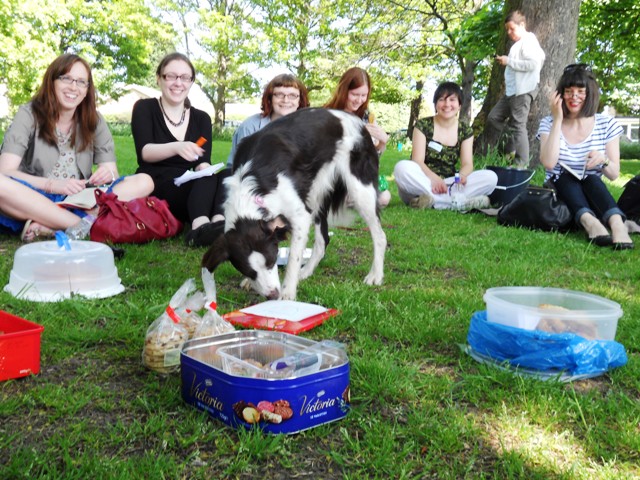
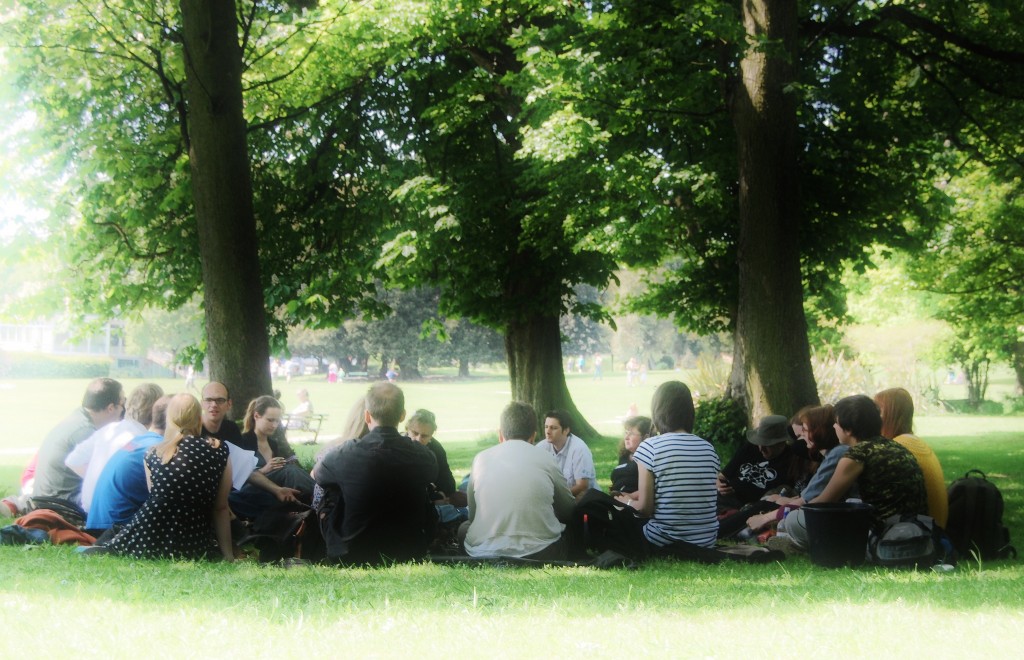
In a masterful move by the organizers we decamped to nearby Hall Park for the afternoon sessions which meant the session I had pitched on library catalogues took place ‘en plein air’. The unconference style made this easy to accomodate though there were some downsides, notably a dog that turned up and dug into Dace‘s salty cheese sticks just as the session was getting started…

Dog joining in with ‘cake camp’, photographed by Dace Udre, license CC-BY-NC.

The anti-social catalogue

Session underway, photographed by Kev Campbell-Wright, license CC-BY-NC-SA.

What is the next-gen library catalogue?

I opened by outlining what we mean by a “discovery interface” or “next-generation library catalogue” to give us some grounding. Then I gave a quick outline of the failure of current library systems to be “social”, that is, how they don’t facilitate social interactions.

I paraphrased from Sharon Yang and Melissa Hoffman’s article (2011) surveying library catalogues. I’ll repeat this below as I know it’ll come in handy in future. What makes something a next-generation catalogue isn’t very well-defined but we can say such a system will have many of these features, whereas traditional catalogues have few:

  • They provide a single point of searching across multiple library resources including the local bibliographic database, journal articles, and other materials.
  • The Web interface is modern and its design reflects that that found in Web search and ecommerce sites rather than traditional bibliographic retrieval systems.
  • They favour keyword searching via a single search box.
  • They feature faceted navigation to rework or limit search results.
  • They are tolerant of user error and provide “Did you mean…?” suggestions.
  • They feature enriched content drawn from sources outside the library such as book jackets, reviews, and summaries.
  • They feature user-generated content such as reviews and tagging.
  • They feature recommendations or suggestions for related material, which may be based on information held in the library system (e.g. circulation data) or elsewhere.
  • They feature some kind of social networking integration to allow for easier sharing and reuse of library records and data on these Web sites.
  • To facilitate this sharing, records have stable persistent links or permalinks.

What are the problems?

Some of the features mentioned above are social in nature, including user-generated content such as tagging and reviews, recommenders built from using circulation data, and integration of social networking sites. So “next-generation” implies a suite of features that include some social features, but not everything next-generation is such a social feature. Furthermore the underlying library management system and metadata are not likely to be too supportive of these features.

In practise social features like tagging and reviews haven’t really taken off in libraries and those of us using these tend to find low use among our customers. This is certainly my experience with tagging, enabled on our Encore catalogue at Senate House Libraries. It is not enough to have a reasonably large bibliographic database and a reasonably large membership then turn on tagging and expect something – the magic – to happen.

I do not think library catalogues are perceived as a social destination by our readers. However I think what prevents this is not that there is no wish by readers to interact in this way using our systems, but that we’re only just starting to make a serious effort to build features that encourage genuine social interaction.

This is what I mean by current catalogues being anti-social. However, I did like this alternative definition from Gaz:

Discussion

Note: attributions below are based on my notes from the day. If I’ve made a mistake please let me know.

The conversation was lively and varied and I was really pleased to facilitate a session where so many present wanted to contribute.

There was a general feeling the current technology isn’t there yet and implementation of social features on our catalogues do not encourage social interaction.

Luke explained catalogues built by vendors reflect the small marketplace offered by libraries and that technology in libraries tends to be quite far behind leading edge. He described the development of VuFind for discovery based on frustration with software supplier offerings – but one that required a willingness to invest in staff resource to develop and implement VuFind. This was done at Swansea University, Swansea Metropolitan University, and Trinity Saint David as a project – SWWHEP.

Luke mentioned something I have heard as a common objection to user-generated content in catalogues, the fear that students will abuse it and tag books with swearwords and so on. There was a similar concern raised that books written by academic staff might be rated down by students (with a cheeky suggestion added – “They should write better books”). Luke pointed out this has not proved a problem on the Swansea iFind implementation of VuFind (as it hasn’t at Senate House Libraries) because the feature is simply not being used. I thought that in some ways the feature being ignored is worse than readers actively disliking it…

Sarah gave an example of a ‘paper-based Web 2.0’ (my term) implementation where library members were given a paper slip to rate or review an item – which would then be keyed into the catalogue by staff!

Several campers made the point bringing in user-generated content from outside – such as Librarything for Libraries – could make a big difference as then there’s clearly something there to start with.

It was generally agreed building features that create good social interaction requires effort, it’s not something we can easily bolt on to existing systems that aren’t designed for this from the ground up.

There was agreement with Iman‘s point that for social features to become popular there should be an incentive for the customer. The customer should get value from the interaction, or what’s the point of doing it? Alongside this it shouldn’t take huge effort or require a great deal of work to be social. The concept of gamification as a way of providing that incentive was raised here.

Several campers gave example of where libraries know great a deal of information about our readers habits and actions, and could re-use this to enhance their experience of the physical or online library. The approach to social features on the catalogue that requires least effort are those interactions that happen by you doing what you would normally do anyway. For example borrowing and returning books to generate recommendations based on circulation information.

One problem was raised about emphasising top loaning items from the collection in that this could become self-sustaining: an item remaining popular because it is on that list. (At this point I wondered that I probably couldn’t make our top-loaning author Michel Foucault any more popular if I tried…)

Liz made a thoughtful point that the use of technology is important, that is how it enables us to fulfil the mission of the organization (the library, the university). We should concentrate on what’s relevant for our organizations. So: we need to be clear what we’re trying to achieve with these features and what the point of it all is. Technology used poorly for its own sake had already been raised, an example given being linking to an ebook record from the catalogue using a QR code: if you’re already online looking at the catalogue, why not just a normal hyperlink?

Rather than limiting ourselves to what other libraries are doing we should be thinking along the lines of features employed in ecommerce systems. Spencer made the interesting point that ecommerce systems he has worked with can build a much more complete picture of user needs and wishes with a view to offering them a tailored online experience. This is years ahead of anything libraries currently do.

Some more fundamental problems were raised about technology and libraries.

Linsey raised the idea of ’embarrassing IT’, that is IT provision that’s so bad we as information professionals are ashamed to offer it. Alison said the technology needs to be there to support new catalogues, or our staff and customers simply can’t make the best use of them. An example given by the group was of an older catalogue remaining popular versus a next-generation system because it’s faster to use on outdated computers provided by the library.

These problems aren’t minor. Feedback from the group was that our Web presence and user experience of our Web sites really influences users’ perception of our organizations. There’s a real need for us to do this well, not half-heartedly.

Acknowledgment

My thanks to Natalie Pollecutt at the Wellcome Library for helpful discussion about the concept of the ‘social catalogue’ ahead of libcampLS.

References

Yang, S.Q. and Hofmann, M.A. (2011). ‘Next generation or current generation?: a study of the OPACs of 260 academic libraries in the USA and Canada’, Library Hi Tech, 29 (2), pp. 266-300. doi:10.1108/07378831111138170

Grouse about your next-generation catalogue – LibCamp@Brunel

A journey to the the wild wild west (of London)

On Saturday 28th January I attended LibCamp@Brunel, a library unconference generously hosted by the library at Brunel University in Uxbridge. I’d not been this far west in London as a destination before and on arriving I was pleased to recognise the tube station at Uxbridge as one of Charles Holden’s designs, which I took as a good omen for the day.

At the opening introduction and pitching, I pitched a session about staff perception versus library user perception of  next-generation library catalogues. As the unconference attendees were by and large library workers, I also wanted to invite everyone to come and grouse about problems they’d had with these systems. And let’s be honest, “Grouse about your next-gen catalogue” is going to be fun.

I had modest expectations for this session but it was very well attended, so much so our allotted space was too small and we had to move somewhere roomier. As I was facilitating I couldn’t live-tweet the session and following a few requests from people who couldn’t attend I decided to expand on the points made to give you a flavour of the discussion.

Perceptions of the catalogue

For some time I’ve been trying to understand problems readers have with the catalogue, and had wondered if it was possible to generalise this to talk about staff versus reader perception of Encore and next-generation systems. I hoped we could work towards this in discussion. As well as Encore, Aquabrowser, VUfind, and Summon were mentioned in discussion.

We’ve come a long way. I expected I would have to define next-generation catalogue in the session, but I was delighted when one of the graduate trainees present explained what I call next-gen was simply what she expected from a normal library catalogue. I had to give a really quick potted history of four generations of catalogue interfaces. (This is how to make your systems librarian feel old…)

I explained our experience of implementing Innovative Interfaces Encore at Senate House Library, and particularly how different I have found the perspectives of the library staff versus our readers. To be clear, my colleagues were almost entirely positive towards the new catalogue. I was pushing at an open door implementing a catalogue that offers a much better experience to readers used to using modern Web sites compared with the previous catalogue, relatively little changed since the 2000s.

However, I think it’s important to answer criticism and deal with objections as there could easily be problems I’d overlooked, and there’s a need to have these arguments as one step in bringing people with you.

Andrew, you can’t implement without feature x

In the early days pre-implementation I heard various objections to Encore along the lines of it being feature-incomplete compared with the previous catalogue. Some of my colleagues were hopeful that it would be possible to put off implementing Encore on this basis: we should wait until the next release, or the next-plus-one release, where these issues would be resolved…

It is correct that the new catalogue:

  • Doesn’t generate any left-to-right phrase indexes as our old catalogue did. Everything is indexed as keywords.
  • Doesn’t deal with classmarks for most of our multitude of classification schemes at all. At all. It doesn’t index them as classmarks and doesn’t allow you to browse by classmark.
  • Has fewer options for presenting a ‘scoped’ view of the catalogue limited to just a particular library or collection.
  • In the version we launched with, didn’t offer an advanced search with pre-limits and didn’t support boolean operators at all. (This has been added since.)

Having already done some user testing of the new catalogue I was reasonably confident none of the missing features were a show-stopper for implementation. If there were problems for some readers, we had a simple solution: allow everyone to continue using the old catalogue in parallel to the old one.

One of the Library Campers had pointed out in advanced this is an unusual approach. I explained further in discussion this was partly by necessity as the ‘patron’ features – the ability to log in to view your loans, place a reservation and renew loans – were still based in the old catalogue anyway.

I was asked about how we make sure readers find and use Encore. To drive reader uptake of the new catalogue I wanted to offer Encore as the default option on that places that really matter to us – on the Senate House Library homepage and on the old catalogue homepage. The latter uses some JavaScript to redirect your search depending on what options you select, but if you keep the default ‘Quick Search’ you get Encore. It was important to me that by following the path of least resistance readers would end up with the new catalogue.

I have said before and I stand by it: if you want to buy and implement a new system you should have the courage in your convictions and implement it properly. It amazes me to see libraries that offer their new discovery interfaces as an “alternative search” that can be ignored, or that requires special effort to find and use. I do see the value in doing this during a public beta test or preview, as the British Library did with Primo (branded as Explore the British Library), but absolutely not when you’ve made it live.

As of January 2012 we see slightly more use of the new catalogue in terms of visits, ~56% of the combined total based on Google Analytics data (I said ~50% based on data from Q4 2011 in the session). I consider this a reasonable start.

In the eight months since going live with the new catalogue several types of problem have emerged with Encore.

Longer term: how staff use the catalogue

It’s surprised me how many unusual uses of the old catalogue interface our staff have built up over time and the extent to which the catalogue has taken on functions I wouldn’t expect. For example, making use of the way classmarks are indexed to produce a list of everything from a particular classmark, particularly useful for Special Collections where the classmark might be used to describe what collection something is in. Or a need to produce a list that represents everything related to some sub-set of our catalogue – that is, a search strategy that you can be confident represents 100% true positives!

Much of this has been presented to me in good humour in a playful spirit of showing me how Encore can be “beaten” by a particular use case.

There are uses of the old catalogue that are simply impossible in the Encore catalogue, but my answer is first they don’t tend to represent realistic use cases our readers make, second they can more or less easily be moved to the staff client for our library system. Apart from Encore, Katharine Schopflin and Graham Seaman discussed how next-generation systems can have problems with known item searching and in attempting to present a search interface biased towards too much towards browsing and subject searching can be actively unhelpful when you have specific items in mind. I explained I think Encore is quite good for known item search, in particular the way it prioritises exact hits from MARC field 245 $a, my favourite examples are journals like Text and Agenda.

Generally I don’t think we should aim every discovery tool only at our most expert users, information professionals with great experience with our collections, when they have working alternatives available. I explained in response to a question there is no staff-specific view of Encore if you sign in using a staff account. I think this is right and proper from a “dogfooding” point of view, but I confess I daydream about a catalogue that is this flexible enough to offer a different interfaces with different features for novice to expert as required…

Longer term: you need to sort out your metadata

It’s become a truism that because next-generation systems make better use of our bibliographic data they force us to sort out existing problems with our metadata. We’ve certainly found our fair share of these problems since launching Encore, but not all of them are fixable.

The first we’ve tried to address is the way different types of material were described in our catalogue, the combination of print monographs (er, books) and print periodicals (um, journals) into a single material type termed “printed material”. Cue amused smiles from the Library Campers! Since then we’ve split them into books and journals as I explain on a blog post on our Encore blog – ‘Helping you find print journals more easily’.

The general problem is Encore can only act on the metadata it has available, but realistically you won’t always have time and money to do the work required to make it good. Encore does useful things like provide facets based on geographical names in your subject headings, or dates of publication, or languages. The problem is the data being missing or coded ‘undetermined’.

We know there are some very good items in our collection that are not findable during subject searching by readers because they have a record that’s not very good. Graham Seaman mentioned a problem in Summon in the way dates can be described in different ways, understandable by humans but not machines. For example you could refer to things from the same time period as ’16th century’, ‘1500–1525’, or ‘Renaissance’ and so miss out on relevant items.

These are problems that existed with our old catalogue but which the next-generation catalogue brings into sharper relief.

Encouraging serendipitous discovery in library catalogues

I’ve been thinking about serendipitous discovery in library catalogues following discussion in Adrienne Cooper’s cataloguing and classification session at Library Camp. I am also much indebted to Owen Stephens for continued discussion about this over lunch.

If you’re unsure about this subject, I recommend Elizabeth Watson’s masters dissertation on serendipity in LIS (PDF). Read it now!

I think the previous and current generations of library catalogues are not supportive enough – or at all in many cases – of serendipitous discovery while browsing. During my masters interviews I found readers at Senate House Library loved that style of discovery far, far beyond what I expected and were eager to talk about their experiences in our library. No-one mentioned using the catalogue for such a thing.

For example:

  • Using the classification to browse nearby shelves, the initial catalogue search used as a rough indication of where to start “proper” browsing.
  • Chancing upon things in unrelated areas of the library. Just wander in and see what’s there. Moving stock around for our refurbishment actually worked in favour of this!
  • Opening a book on the reshelving area. The argument is previous borrowing is some indication of usefulness.
  • Journals too: I know of a prof. who prefers print journals because you can flick through a current issue and chance on unexpected things.

Sadly I had nowhere near enough words available in the dissertation to expand on this and it was somewhat off-topic anyway.

Katie Birkwood said, commenting on a post at the “What’s the point?” cataloguing blog:

“I had a thought recently, sort of on the back of mentions of ‘serendipty’ of discovery […] what if all or some of this perceived ‘serendipty’ is nothing of the kind, but is instead the result of careful classification?”

I think that’s true, and moreover I think the major benefit of classifying items rather than just bunging them on the shelf and numbering them. I think we lose something in relegating a lot of stock to closed stores as this style of discovery diminishes too.

It’s an unsolved problem to support serendipitous discovery online. In theory an online catalogue should be good at this because it isn’t really limited by space and includes the possibility of hyperlinking things together…

There have been attempts to replicate the experience of print items. For example a “shelf browse” type of view – but that’s missing the obvious: you can’t pick the thing up and flip through it, plus you limit yourself to the view of the collection imposed by your classification, as good as it is, you’re not encouraging random connections.

I would love to see a library catalogue with some awareness of what those funny numbers and letters in classmarks actually mean. Offering a browse view of classmarks in a list is one thing, and useful for power users, but what a step forward if the catalogue had some understand of what say 303.48330904 means and how that could be related to other classes.

An approach I find very interesting is recommender systems. This was discussed in Helen Harrop’s and Dave Pattern’s session on the same at Library Camp where Dave linked them to serendipity  – a recommender being one of the ways of reproducing the ‘joy’ of accidental discovery online. Helen argued there is a wealth of data in library management systems that could be used to create these connections, the basic idea being “People who borrowed X also borrowed Y” or similar.

I remember being very impressed with the LibraryThing for Libraries recommender when I first saw it make a connection between Charles Mackay’s Extraordinary popular delusions and the madness of crowds and a book on Dutch tulips, the former having a chapter unknown to me about the tulip craze. Years on I just take that sort of thing for granted on LibraryThing, but relatively few academic libraries have started using recommenders in earnest.

This is one reason why I’ve made ‘patron reading history’ opt-out in our catalogue for the academic year just started.

References

Watson, E.A. (2008) Going fishing: serendipity in library and information science. Unpublished MS dissertation. University of North Carolina at Chapel Hill [Online]. Available at: https://cdr.lib.unc.edu/concern/masters_papers/b5644w56s