Introduction
At Senate House Libraries, University of London we’re part way though our project to migrate our library management system (LMS) to Kuali OLE, a Free Software / Open Source library services platform. As a deliberate design choice OLE does not come with an online catalogue for end users, so we are approaching discovery as a work package in our LMS project. To this end I recently ran focus groups for staff to start to specify what goes into a functional specification for our discovery system.
Part way into writing my summary of the high-level requirements I realised I was writing something like a manifesto. I stopped and split this into a separate page in our Confluence wiki, and this is what I wanted to share with you. If you want to see something more like a specification for a library discovery / vertical search system, take a look at Ken Chad’s libtechrfp site on Vertical Search as a starting point.
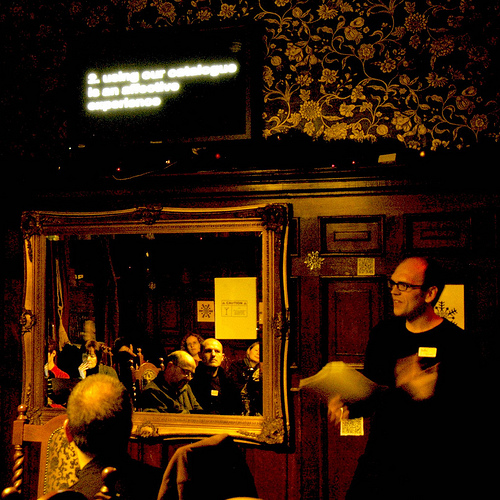
Running focus groups
From my point of view it’s liberating to start with a clean slate for discovery and not with the limitations of existing library vendor solutions. There are a whole host of implications here, primary for me are not being tied to vendor development roadmaps and technology choices, and not having limitations from the LMS carry through to the discovery layer. So, I wanted to start with an open mind and not presume too much about staff received opinion or staff use of our existing discovery systems.
I asked participants to think about some questions as a prelude to a mix of small- and big-group discussion in a workshop context.
- What’s valued in our current discovery systems, and what are outstanding problems?
- What’s missing that should be included in the next discovery system?
- What’s most important to researchers?
- What would a good discovery system look like, and how would it behave?
I have to apologize for management-speak of asking what does good look like, but it’s a serious point. It is incredibly hard to describe what a successful new system would be like to use, but these are the things we need to be thinking about rather than say, a list of missing features in Innovative’s Encore Discovery versus their older WebPAC Pro catalogue.
Just to add that yes, testing with library members is to follow. This will include the usual usability testing that accompanies and informs any sensible, well-designed web project and also a more in-depth investigation into user behaviour using ethnographic methods.
“[We want] the moon on a stick”
These group discussions were incredibly productive and featured a good deal of imaginative and daring thinking about what a library catalogue should be and how it should behave. My favourite headline from these small group discussions was a page titled, “the moon on a stick”. I think this is a good starting point: we should think big and aspirational, not small and limited.
Our goal should be full discovery of everything including searching across books, journals, archives, images, and so on in a way that is clear about what you’re searching and provides options to include and exclude different content. In this context the local bibliographic database becomes the biggest of several databases that discovery draws from alongside the archives catalogue, eprints repository, and digital asset management system.
Unfolding complexity
So, how do we provide breadth and depth of discovery without overwhelming the reader with a firehose-like experience of masses of information; and impossible complexity that requires a LIS masters degree to understand?
The key point for us is discovery needs the ability to be as simple or complex as you want to at any given time. We need a way of providing a range of levels of complexity in the same system rather than hiding all the complexity behind an ‘advanced search’ link.
This doesn’t just mean copying from web search, as a single search box is very difficult to get right in the library context. Even if many libraries are going this way nowadays it is very hard to do it well and impossible to please everyone. On the one hand, old school OPACs rely too much on specialist knowledge of how the catalogue works and the structure of the underlying metadata that powers them. On the other, library attempts at single search boxes use keyword indexes that fail to make best use of the complexity and richness of that underlying metadata.
Instead we need an approach that respects the intellectual ability of our readership and the status of our institution, and respects the reader’s conceptual understanding of the library. Our approach should reflect the pride we have in being a library and our professional abilities as librarians, without attempting to turn readers into mini-librarians.
Discovery must include ways of bringing in complexity from a simple starting point, something web search engines can do quite well.
Readers shouldn’t feel they’re starting from a position where they’re telling the library, “I’m stupid”, or “I’m intelligent”. Discovery needs to reconcile providing a simple starting point with surfacing information that may be relevant, but is deep and complex. We know that buried somewhere in the clutter are results that are useful to the reader. The underlying technology may be very complicated but the experience of the system should be the opposite.
We need to meet the needs of different groups of users, or the differing needs of the same user. We know there are primary and secondary uses of our collections for the same person, and a reader may have a different approach in a different context depending on what they are using us for. Staff are users of the catalogue and discovery tools should be easier for staff, too.
User experience
To inform this ‘unfolding complexity’, discovery must bring in user experience concepts and best practise from elsewhere in and outside libraries. The starting point in our thinking here is discovery should be navigable like a modern web site is, and to achieve this it will be designed in a similar way to how our our website was designed. That is, similar approaches and techniques given a library spin that respects our role and the reasons readers choose to sign up for membership.
User experience is key to our web presence but it must be a theme throughout the services we offer: it can’t stop at the library website. There is a gulf between library websites and library catalogues and discovery that we need to bridge. Libraries spend time and money building good websites, but you’ll still find terrible usability when you move over to their catalogues. John Blyberg sums this up as:
John Blyberg says: “You may have the best website in the world, but when your user click on Catalog–BOOM, they’re in the ghetto.” #cil2010
— Sarah Houghton (@TheLiB) April 13, 2010
The problem lies with inflexible and outdated systems rather than no-one bothering with usability testing or not caring about their readers. Our next discovery system can’t be another weird product from Libraryland that is disconnected from the approach we take when building our websites.
Objecting to my own methodology
I’d like to end on a little reflection about methodology and our subjective views of catalogues based on our experience and familiarity.
Many staff expressed a wish for a “simple”, “uncluttered”, “user friendly”, or “intuitive” interface as contrasted with a “busy”, “cluttered”, or “clunky” interface. I understand these wishes, and I think there is a certain know it when I see it gut feeling about overall user experience that makes something “simple” or “clunky”, but intellectually I know it’s difficult to unpack what these terms mean as they’re so subjective. You might guess a concern here is a term like “user friendly” being used as a proxy for personal preferences or familiarity, and there is a contrast between familiarity of staff traditional information retrieval interfaces versus familiarity of readers with modern websites that I think is important too.
So we do need to dig in! At this point the workshop format breaks down because it’s difficult to employ methods such as close questioning or laddering in a group work situation, you really need a one-to-one interview. However, I tried to unpick this as much as possible in the focus groups without anyone feeling too interrogated. For example, if the Encore feel is “cluttered” what is it that would improve it? What is it about the classic WebPAC Pro or another catalogue that is uncluttered?
I can see a danger here in acting as an interpretive layer or a translator between what someone says and what I think they really mean, and then how I think that should be implemented in a new discovery layer. In hindsight I wish I could’ve sat everyone down one-to-one and ran through some repertory grids to allow for comparisons between different catalogue interfaces based on those constructs such as “clutteredness”.
I had done this in my masters dissertation on library catalogue user experience and found it works really well, once you get over it being an “out-there method” (I smiled in agreement when I read that in Lauren Smith’s recent blog post on fieldwork).
This is something I may try as part of testing options for discovery interfaces such as VuFind and Blacklight.
Acknowledgements
Thanks to Andrea Meyer-Ludowisy (Research Librarian, Western European Languages) and Joe Honywill (Associate Director, Digital Futures) at Senate House Libraries for helpful discussion on the subject.