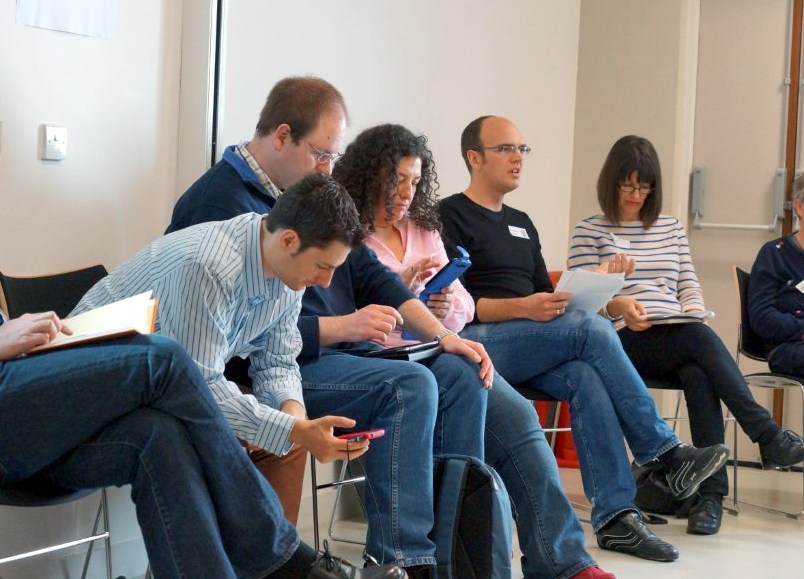
A quick update about Library Camp London (#libcampldn) as I have been asked many questions on Twitter and by email this week.
We released general tickets on the afternoon of Monday 10th December. I did this about 2 pm and the response was spectacular, in about an hour we’d ‘sold’ them all and were building up an Eventbrite waitlist. I released a further 30 tickets to clear the waitlist.
We now have 100 library campers registered including advance tickets we released earlier for library and information students.
A round of applause for the #libcampldn organisers. Sold out within the hour.
Thank you for your interest in Library Camp London. The excitement and buzz on Twitter and offline, especially people wanting to be involved in organizing and talking about their session ideas has been wonderful. What next?
If you are interested in attending Library Camp London, please join the waitlist. This is because when we release more tickets those already on the waitlist will be offered them first.
Venue
I am working with my employer (and Library Camp host) Senate House Library, University of London to make more space available for Library Camp London.
We want Library Camp London to be as inclusive and diverse as possible. In particular although we’re hosting the event at an academic library, it’s not focused on academic libraries or higher education. For this reason we’re making a case to make the event bigger.
Ticketing
There will be at least one further ticket release for Library Camp London. This is likely to be in January 2013.
Please watch for announcements from me (@preater) and the other organizers Gary (@ggnewed) and David (@davidclover) on twitter.
On Saturday 13th October I attended the ‘big’ Library Camp 2012 unconference (libcampuk12) at the Signing Tree Conference Centre, Birmingham.
Liz Jolly and I pitched a session on the use of Free and Open Source software in libraries, with a particular focus on discussing the cultural changes or cultural shift needed to develop and sustain the use of in libraries, a typically risk-averse environment. This idea came out of a #uklibchat discussion on Open Source software back in July – thanks to Adrienne Cooper for organizing that.
This session was prepared and facilitated jointly. However when I write “I”, “me”, etc. below I am talking about my own views and experience.
Introduction
In the session asked we use Open Source and Free Software as interchangeable terms that are close enough in meaning that Library Campers could use either term. I realize, and accept, there are objections to doing this. I will refer to FOSS meaning “free and open source software” below.
I explained that Open Source is a pragmatic model of software development where you are allowed access to the source code of the software, however it – and moreover the older concept of Free Software – are underpinned by a philosophy based around respecting users’ freedom and fostering community. Drawing on this we wanted to open with the “four freedoms” in the Free Software Definition (Free Software Foundation, 2012) and how they tie into our professional culture. This list is written by a computer scientist, so famously it starts from zero!
The freedom to run the program, for any purpose (freedom 0).
The freedom to study how the program works, and change it so it does your computing as you wish (freedom 1).
The freedom to redistribute copies so you can help your neighbour (freedom 2).
The freedom to distribute copies of your modified versions to others (freedom 3).
We argued that in higher education and librarianship in particular, these freedoms are broadly aligned to our own professional culture. Universities have a culture of sharing both internally and externally, and also between those working in the same disciplines across institutions. Furthermore, both within and without higher education, librarianship is a particularly collaborative profession.
However, in the broader cultures of higher education we face various problems. In some ways the Four Freedoms are in opposition to the broader organizational culture we work in. We identify points of tension for universities and libraries as collaborative organizations working within power structures that do not necessarily agree with or support a collaborative approach. This is especially the case in our current political and financial climate, where increased competition between institutions will to an extent mitigate against a collaborative culture.
We wondered if perhaps this is mainly a problem within perceived “competitor” institutions, I asked if anyone finds themselves discussing things more openly with colleagues in sectors or institutions that you don’t consider a “threat” or competitor to your own?
FOSS and the culture of libraries and education
Culturally, one starting point is looking at where we still find institutional resistance to FOSS. By this I mean beyond myths like FOSS implying that you have to “build it yourself”, or that “you need to employ programmers”, rather I mean resistance to FOSS as a concept itself. I have seen some of this in my career in further and higher education, but I would say nowadays I think this attitude is dying off. Personally I find myself anticipating resistance to FOSS that simply doesn’t materialize – or in many cases I actually find enthusiastic approval for FOSS.
I am sure our experiences here vary widely – certainly buy-in from senior managers is essential and having one particularly pro- or anti-FOSS manager can make a huge difference either way. Several participants contributed here with examples from their own public sector experience where projects already in development had been scuppered when they were found to be using FOSS, and explained further that they did still spend time knocking down some very old-fashioned arguments about FOSS versus closed source such as needing to “have someone to sue when it all goes wrong”.
There was general agreement that certain sectors are worse at this than others, with libraries in local government and the NHS picked out as particularly difficult: public libraries having to accept whatever systems their authority decides on with limited or no change, and the NHS wanting to play especially safe.
One contradiction in higher education is we have a very long history of using FOSS for the services that underpin our systems (the concept of Free Software was born in higher education, when Richard Stallman was at MIT (Stallman, 2010) but a reluctance to actually use FOSS for campus-wide and departmental systems. What do we mean by this? At a basic level FOSS gives us the building blocks such as web and database servers, programming and scripting languages that we need to create software and services. Few of our IT and systems colleague would object to for example using a FOSS Web server or content management system – but notice how few FOSS library management systems are deployed in the UK, for example.
As a cultural aspect of this we would ask if library and education managers have enough in-depth knowledge of principles of technology, including FOSS, and how it can benefit their organisation to successfully govern projects and to engage with wider community? In universities there is an approach to promoting managers on academic excellence rather than strategic management ability, but these would be the people chairing project boards.
One example here is Moodle, a FOSS virtual learning environment – some argue that while the use of Moodle in higher education is growing, there is a relative lack of engagement with the community – possibly because of the aspect of knowledge culture in higher education of a fear of “exposure”, of not knowing? Oddly, we note that universities can prove not the best learning communities as we don’t like to admit when don’t know things! We also noted at a higher level a culture of “not invented here” exists in UK higher education (most obviously in nationally-funded projects) where we fail to learn from what others have done elsewhere. Or worse in some cases actively dismiss experience elsewhere because it is not our own idea.
How we buy software, and the “library mindset”
At this point I apologized to my fellow Library Campers for I was going to talk about… project management.
I argue the prevailing approach to software procurement and management in libraries works against FOSS. By this, I mean the approach to procurement or ‘invitation to tender’ that includes implicit assumptions that we are purchasing products from a software supplier or “vendor”. That said, we can actually specify and purchase FOSS in this way – what we are doing is buying the same support from a vendor but the product itself is FOSS. In the public sector, that support might require a tendering process over a certain threshold amount. Luke O’Sullivan pointed out here there is a procurement framework for purchasing FOSS systems available at the LibTechRFP wiki.
We noted that very few actually do this. A recent example is Staffordshire University where Dave Parkes and colleagues worked hard to research and justify choosing the Koha Open Source ILS, supported by PTFS Europe (Johnson, 2010). From a systems point of view it’s notable that Koha is quite a traditional LMS, and can go up against other similar systems using the full UK LMS Core Specification.
I would argue systems like the LMS and resource discovery are really about enterprise information, by this we mean they are among our key systems enabling learning and teaching, research, and other business activities in our universities. These systems are therefore business critical and should be viewed as such. However in universities this typically has never been the case. The LMS tends to be seen as a system that is “just there”, in the library – something that doesn’t need too much attention from IT or the broader university.
This ties in with an approach to user acceptance and testing that does not really exist in higher education, but should as the risks are that spreading around bad data between library and other systems in your university can cost you real money. We argued that librarians should look at software projects from a viewpoint of a “testing mentality”: what is it doing? What effect does it have on other parts of the system and on our other data? Librarians as information professionals should have a role to play here. This is not technical, but about information. More broadly Kate Lomax mentioned there’s a lot you can do to contribute without being a developer or a techie – for example documentation.
I argue these points about how we’ve viewed our previous systems and how we procure them has created something of a “library mindset” in our culture. I feel that as library workers we’ve been complicit in this, and worse in library systems and IT we often take the safe option which can limit our outlook and willingness to risk new things. This is even while we’re very happy using FOSS on own our own computers, or as some participants mentioned “sneaking in” FOSS programs behind the back of unwilling IT departments.
What changes everything in our view are FOSS products in library management systems, discovery, finance, student management, and virtual learning environments that are now becoming mature and mainstream.
EPrints was mentioned in the session – this is widely used in higher education repositories with commercial support and consultancy services available (including from my own IT department, ULCC).
Conclusion
As a kind of coda we explained that issues around governance, testing methodology, documentation, change management and so on applies to so-called closed-source software just as much as it does to FOSS, and we’d say good project management and software development practice applies regardless of development model use.
As a FOSS developer, Luke emphasized the importance of governance, testing and providing a stable service alongside development. He explained that FOSS is incredibly exciting because you can work with the source code to make changes to suit your local needs – but you risk getting totally carried away. Culturally this represents a real change for library workers not used to this flexibility, so there’s a danger of too much demand on programming time if the assumption is anything about the system can be altered to meet local needs.
The strategic issues here for FOSS projects are around effective management in terms of inclusivity, collaboration and transparency, project governance frameworks, quality and risk management, procurement policies, and change management. These are not specific to an FOSS approach but we argue, essential for such an approach to be successful and specifically to address the traditional weaknesses found in FOSS projects.
Acknowledgement
My thanks to Sharon Penfold, Project Manager at the Bloomsbury LMS for helpful discussion on this subject around procurement, data, testing, and project management.
Johnson, P. (2010) ‘Staffordshire University chooses Koha for its new library system’. Available at: https://web.archive.org/web/20160320053630/http://blogs.staffs.ac.uk/informationlandscape/2010/12/10/staffordshire-university-chooses-koha-for-its-new-library-system/
On Saturday 28th January I attended LibCamp@Brunel, a library unconference generously hosted by the library at Brunel University in Uxbridge. I’d not been this far west in London as a destination before and on arriving I was pleased to recognise the tube station at Uxbridge as one of Charles Holden’s designs, which I took as a good omen for the day.
At the opening introduction and pitching, I pitched a session about staff perception versus library user perception of next-generation library catalogues. As the unconference attendees were by and large library workers, I also wanted to invite everyone to come and grouse about problems they’d had with these systems. And let’s be honest, “Grouse about your next-gen catalogue” is going to be fun.
I had modest expectations for this session but it was very well attended, so much so our allotted space was too small and we had to move somewhere roomier. As I was facilitating I couldn’t live-tweet the session and following a few requests from people who couldn’t attend I decided to expand on the points made to give you a flavour of the discussion.
Perceptions of the catalogue
For some time I’ve been trying to understand problems readers have with the catalogue, and had wondered if it was possible to generalise this to talk about staff versus reader perception of Encore and next-generation systems. I hoped we could work towards this in discussion. As well as Encore, Aquabrowser, VUfind, and Summon were mentioned in discussion.
We’ve come a long way. I expected I would have to define next-generation catalogue in the session, but I was delighted when one of the graduate trainees present explained what I call next-gen was simply what she expected from a normal library catalogue. I had to give a really quick potted history of four generations of catalogue interfaces. (This is how to make your systems librarian feel old…)
I explained our experience of implementing Innovative Interfaces Encore at Senate House Library, and particularly how different I have found the perspectives of the library staff versus our readers. To be clear, my colleagues were almost entirely positive towards the new catalogue. I was pushing at an open door implementing a catalogue that offers a much better experience to readers used to using modern Web sites compared with the previous catalogue, relatively little changed since the 2000s.
However, I think it’s important to answer criticism and deal with objections as there could easily be problems I’d overlooked, and there’s a need to have these arguments as one step in bringing people with you.
Andrew, you can’t implement without feature x…
In the early days pre-implementation I heard various objections to Encore along the lines of it being feature-incomplete compared with the previous catalogue. Some of my colleagues were hopeful that it would be possible to put off implementing Encore on this basis: we should wait until the next release, or the next-plus-one release, where these issues would be resolved…
It is correct that the new catalogue:
Doesn’t generate any left-to-right phrase indexes as our old catalogue did. Everything is indexed as keywords.
Doesn’t deal with classmarks for most of our multitude of classification schemes at all. At all. It doesn’t index them as classmarks and doesn’t allow you to browse by classmark.
Has fewer options for presenting a ‘scoped’ view of the catalogue limited to just a particular library or collection.
In the version we launched with, didn’t offer an advanced search with pre-limits and didn’t support boolean operators at all. (This has been added since.)
Having already done some user testing of the new catalogue I was reasonably confident none of the missing features were a show-stopper for implementation. If there were problems for some readers, we had a simple solution: allow everyone to continue using the old catalogue in parallel to the old one.
One of the Library Campers had pointed out in advanced this is an unusual approach. I explained further in discussion this was partly by necessity as the ‘patron’ features – the ability to log in to view your loans, place a reservation and renew loans – were still based in the old catalogue anyway.
I was asked about how we make sure readers find and use Encore. To drive reader uptake of the new catalogue I wanted to offer Encore as the default option on that places that really matter to us – on the Senate House Library homepage and on the old catalogue homepage. The latter uses some JavaScript to redirect your search depending on what options you select, but if you keep the default ‘Quick Search’ you get Encore. It was important to me that by following the path of least resistance readers would end up with the new catalogue.
I have said before and I stand by it: if you want to buy and implement a new system you should have the courage in your convictions and implement it properly. It amazes me to see libraries that offer their new discovery interfaces as an “alternative search” that can be ignored, or that requires special effort to find and use. I do see the value in doing this during a public beta test or preview, as the British Library did with Primo (branded as Explore the British Library), but absolutely not when you’ve made it live.
As of January 2012 we see slightly more use of the new catalogue in terms of visits, ~56% of the combined total based on Google Analytics data (I said ~50% based on data from Q4 2011 in the session). I consider this a reasonable start.
In the eight months since going live with the new catalogue several types of problem have emerged with Encore.
Longer term: how staff use the catalogue
It’s surprised me how many unusual uses of the old catalogue interface our staff have built up over time and the extent to which the catalogue has taken on functions I wouldn’t expect. For example, making use of the way classmarks are indexed to produce a list of everything from a particular classmark, particularly useful for Special Collections where the classmark might be used to describe what collection something is in. Or a need to produce a list that represents everything related to some sub-set of our catalogue – that is, a search strategy that you can be confident represents 100% true positives!
Much of this has been presented to me in good humour in a playful spirit of showing me how Encore can be “beaten” by a particular use case.
There are uses of the old catalogue that are simply impossible in the Encore catalogue, but my answer is first they don’t tend to represent realistic use cases our readers make, second they can more or less easily be moved to the staff client for our library system. Apart from Encore, Katharine Schopflin and Graham Seaman discussed how next-generation systems can have problems with known item searching and in attempting to present a search interface biased towards too much towards browsing and subject searching can be actively unhelpful when you have specific items in mind. I explained I think Encore is quite good for known item search, in particular the way it prioritises exact hits from MARC field 245 $a, my favourite examples are journals like Text and Agenda.
Generally I don’t think we should aim every discovery tool only at our most expert users, information professionals with great experience with our collections, when they have working alternatives available. I explained in response to a question there is no staff-specific view of Encore if you sign in using a staff account. I think this is right and proper from a “dogfooding” point of view, but I confess I daydream about a catalogue that is this flexible enough to offer a different interfaces with different features for novice to expert as required…
Longer term: you need to sort out your metadata
It’s become a truism that because next-generation systems make better use of our bibliographic data they force us to sort out existing problems with our metadata. We’ve certainly found our fair share of these problems since launching Encore, but not all of them are fixable.
The first we’ve tried to address is the way different types of material were described in our catalogue, the combination of print monographs (er, books) and print periodicals (um, journals) into a single material type termed “printed material”. Cue amused smiles from the Library Campers! Since then we’ve split them into books and journals as I explain on a blog post on our Encore blog – ‘Helping you find print journals more easily’.
The general problem is Encore can only act on the metadata it has available, but realistically you won’t always have time and money to do the work required to make it good. Encore does useful things like provide facets based on geographical names in your subject headings, or dates of publication, or languages. The problem is the data being missing or coded ‘undetermined’.
We know there are some very good items in our collection that are not findable during subject searching by readers because they have a record that’s not very good. Graham Seaman mentioned a problem in Summon in the way dates can be described in different ways, understandable by humans but not machines. For example you could refer to things from the same time period as ’16th century’, ‘1500–1525’, or ‘Renaissance’ and so miss out on relevant items.
These are problems that existed with our old catalogue but which the next-generation catalogue brings into sharper relief.
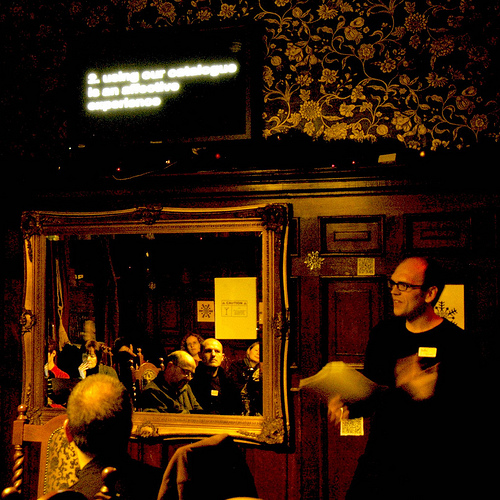
This is posted to coincide with the ChrisMash Mashed Library event organised by Gary Green in London on December 3rd. I spoke about the outcomes of an investigation into user experience and understanding of the next-gen catalogue and next steps we’re taking at Senate House Library. Not very Christmassy I admit…
‘@preater’s presentation’ on Flickr by Paul Stainthorp, license CC-BY-SA.
My slides were kept deliberately simple – it was presented in a pub on a flat screen TV! Notes are included to explain things further. Please get in touch if you want to ask anything about this.
Starting point
We implemented Encore from Innovative Interfaces in June to run alongside and partly replace the older WebPAC Pro catalogue, also from Innovative. Our Encore instance is here; the search I used in my talk was ‘industrial workers of the world‘.
Ahead of implementing we didn’t have much idea about how library users would understand this type of catalogue, so for my masters dissertation I had a look at this using various qualitative methods:
Usability-test style cognitive walk-throughs, done almost as a warm-up but providing lots of interesting data. As an aside I think every library should be doing this with their catalogue – it is so quick and easy to do.
A semi-structured interview using repertory grid technique. This was very good for comparing what my participants really thought of each type of catalogue.
Key findings
To summarise very briefly:
A Web-like catalogue encourages Web-like behaviour
Putting readers in front of a catalogue interface that looks and behaves like a Web search engine results in behaviours closer to a Web search engine than traditional information retrieval.
By this I mean:
A tendency to scan and skim-read Web pages quickly, concentrate on titles.
A process of iterative searching based on using a few keywords and then reworking the search over again based on what’s found on the results page.
Trust in the relevancy ranking of the catalogue; an expectation that the catalogue should be tolerant of small errors or typos via ‘did you mean…?’ suggestions.
The tendency to ‘satisfice’, meaning making do with results that seem good enough for the purpose rather than searching exhaustively.
The view that a search queries are an ongoing process, not something that should produce a single perfect set of results.
Caution: this is based on coding qualitative data from nine people and is not intended to be absolute or apply to every user. I found strongly contrasting opinions of the catalogue with an overall tendency for younger readers to take to the new interface much more easily.
The method I used was inductive, that is developed from analysis of what I observed. I really did not expect this ahead of time.
Using our catalogue is an affective experience
I found there was a strongly affective or emotional response to use of our catalogue beyond what you’d think you might get from using a mere lookup tool. The response was about more than just the catalogue being pleasant to use or familiar from other sites.
This was very interesting because I do not see why a library catalogue should not be a joy to use. Why should library catalogues be a painful experience where you have to “pay your dues”? Even if we changed nothing else behind the scenes and made the catalogue more attractive, you could argue this would improve things because we tend to believe more attractive things work better because they’re more enjoyable. Here I am paraphrasing from Don Norman (2004).
Next steps
Usability testing gets us so far, but as I’ve said previously in an artificial “lab” setting it does not produce natural behaviour. That’s a problem because we don’t get to see the reader’s true understanding emerge. We don’t get to see how they really behave in the library when using the catalogue.
I went fairly far in comparing systems – WebPAC Pro versus Encore – but what anchored that testing was the old catalogue. Having implemented the new catalogue and positioned it fairly aggressively as the default interface I wanted to dig deeper and better understand how the catalogue fits in to the reader’s experience of doing research at Senate House Library.
Think about the experience of library use: the reader comes in and experiences an entire “ecology”: the physical building; print book and journal collections; e-resources; the library staff; our catalogues and Web sites. I wanted to better understand how readers experience the catalogue in this context rather than just thinking about it in systems terms as a tool for looking items up that is used with a particular rate of error or success.
Towards ethnographies of the next-gen catalogue user
What we’re going to do is borrow techniques from anthropology to do ethnography in the library. This means studying and observing readers in their habitat: as they work in the library and do their research.
The outcomes I want from this are fairly “soft”, based around our staff knowing the readers better. What I want to know is: how can the library better support our readers’ use of the catalogue and improve their experience of Senate House Library? This is fundamental: I think without better understanding our readers use of our catalogues, we can’t start to improve what we do and provide a better service.
Properly speaking this is more a case of “borrowing ethnographic methods” than “doing ethnography”. This is OK as the methods aren’t owned by one field of social science, as Harry Wolcott (2008) says they “belong to all of us”.
Practically, what want to do is use a battery of techniques including semi-structured interviews, observation, and close questioning to generate data that will allow development of theory from that data as it is analysed qualitatively. This is a grounded theory approach. The actual work will likely be small “micro ethnographies” done over a period of some months in the library.
Examples
In my talk I mentioned some examples of ethnographic research done in libraries, these are:
Investigating user understanding of the library Web site – University of North Carolina at Charlotte (Wu and Lanclos, 2011)
Looking at how the physical library space is used – Loughborough University (Bryant, 2009)
Ethnographies of subject librarian’s reference work – Hewlett Packard Library and Apple Research Library (Nardi and O’Day, 1999)
Bryant, J. (2009) ‘What are students doing in our library? Ethnography as a method of exploring library user behaviour’, Library and Information Research, 33 (103), pp. 3-9.
Nardi, B.A. and O’Day, V.L. (1999) Information ecologies. London: MIT Press.
Norman, D.A. (2004) Emotional design. New York, NY: Basic Books.
Wolcott, H.F. (2008) Ethnography: a way of seeing. 2nd edn. Plymouth: AltaMira.
Wu, S.K. and Lanclos, D. (2011) ‘Re-imagining the users’ experience: an ethnographic approach to web usability and space design’, Reference Services Review, 39 (3), pp. 369-389.